
By Abdulkarim Ibrahim
At a time when public confidence in government institutions is often weakened by stories of corruption and abuse of office, acts of honesty within public service stand out powerfully.
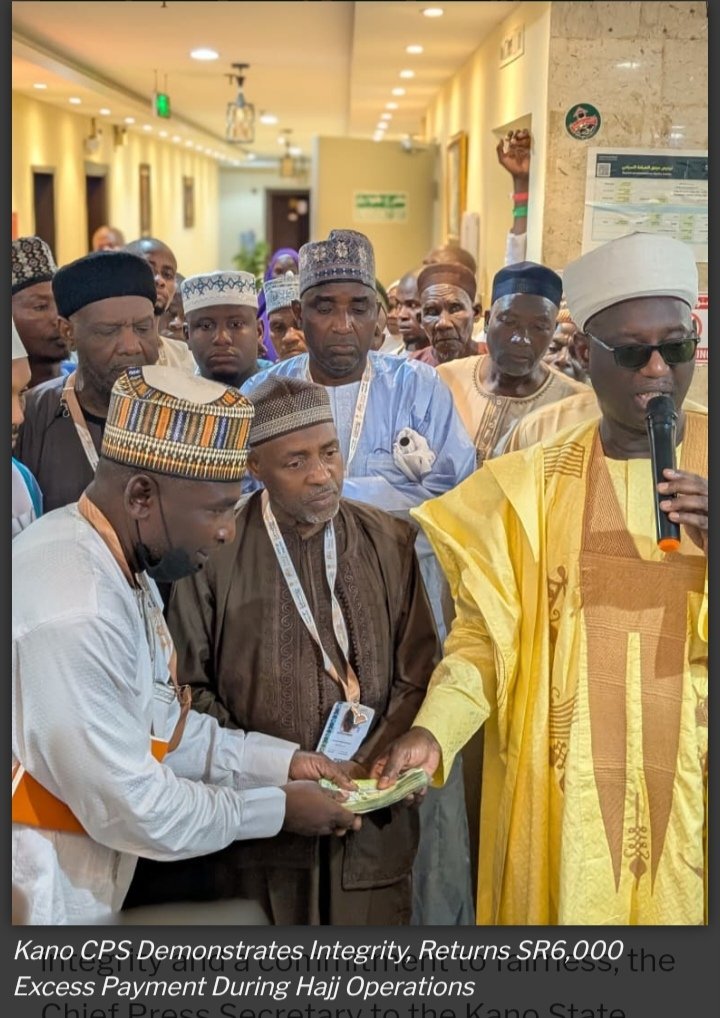
Such was the case when the Chief Press Secretary to Kano State Governor, Malam Mustapha Muhammad, returned an excess payment of SR6,000 approximately N2.4 million mistakenly paid to him during the disbursement of allowances for journalists covering the 2026 Hajj pilgrimage in Saudi Arabia.
What could have easily been ignored became a defining moment of integrity.
Upon discovering the overpayment, Mustapha Muhammad immediately refunded the money to ensure accountability and proper distribution to rightful beneficiaries.
In a society where many public officials are often accused of placing personal gain above public trust, his decision offered a refreshing example of ethical leadership.
The significance of the gesture lies not merely in the amount involved, but in the principle it represents. Mustapha understood that public funds are a sacred trust and that keeping money not rightfully his would amount to denying others their legitimate entitlements.
For those who have known him over the years, however, the action came as no surprise.
As someone who interacted closely with Mustapha Muhammad during our university days, I can confidently attest that integrity has always been one of his defining qualities.
He was disciplined, hardworking and deeply committed to fairness. Even as a student, he strongly believed that success should come through merit and honest effort rather than shortcuts or manipulation.
Those values have remained consistent throughout his professional journey.
Many who worked with him during his time as an international journalist with global media organisations such as the BBC and Bloomberg would likely testify to the same qualities of professionalism, honesty and accountability.
Character is often revealed not during moments of public attention, but through everyday choices and conduct. In Mustapha’s case, the consistency of his values over time is what makes this gesture especially remarkable.
His action also sends an important message to public office holders across Nigeria.
Every day, public officials face decisions that test their integrity. Some involve huge sums of money, while others appear minor. Yet honesty is not measured by the amount at stake, but by the willingness to do what is right even when nobody is watching.
Public office is fundamentally a trust, and that trust can only survive when ethics are placed above personal benefit.
The commendation by the Amirul Hajj and Emir of Gaya, Dr. Aliyu Ibrahim Abdulkadir, was therefore timely and appropriate. By describing the act as one rooted in fairness, responsibility and integrity, the Emir acknowledged the importance of celebrating honesty in governance.
Beyond commendation, however, this moment presents an opportunity for Governor Abba Kabir Yusuf to reinforce the values his administration seeks to promote.
Recognising Mustapha Muhammad’s conduct through a formal commendation or public acknowledgement would send a strong message across the public service that integrity matters and ethical behaviour is appreciated.
Governments often focus on punishing corruption, which is necessary. But rewarding honesty is equally important. Recognition creates role models, strengthens institutional values and encourages others to uphold high ethical standards.
Ultimately, this story is bigger than SR6,000 or N2.4 million.
It is about character, accountability and the courage to choose conscience over convenience. In returning money that did not belong to him, Mustapha Muhammad has demonstrated that integrity is still possible in Nigerian public service.
At a time when Nigerians are searching for leaders they can trust, his action serves as a reminder that good governance begins with personal honesty. Kano State should celebrate this example, and public institutions across the country should encourage more acts of integrity that strengthen public confidence in leadership.
Abdulkarim Ibrahim is Director of Planning, Research and Statistics, Office of the Head of Civil Service, Kano State