
By Gabriel Ameh
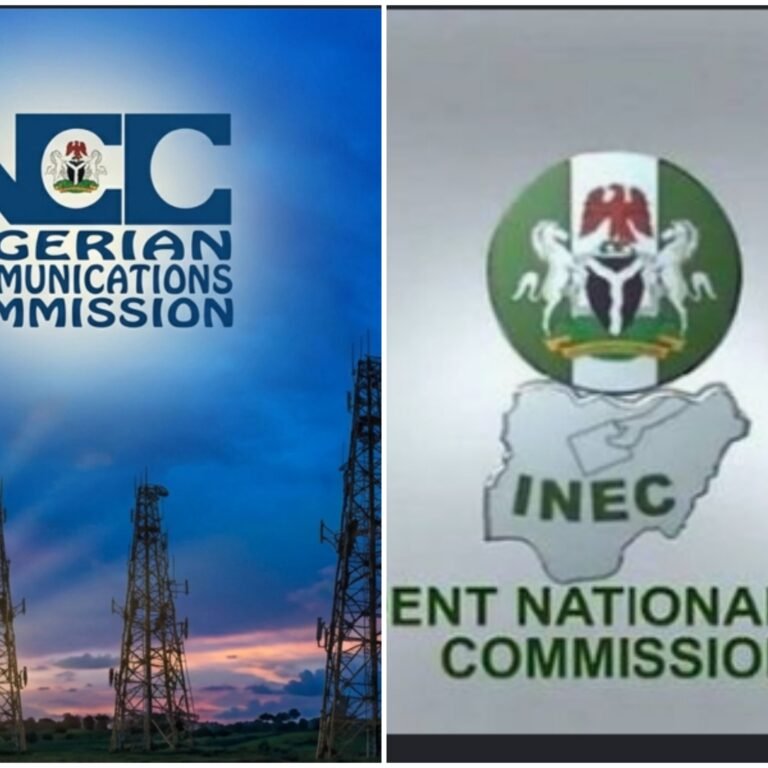
When Nigerians hear INEC, they think of elections, PVCs and voting.
When they hear NCC, many think of network problems, data, SIM cards and telecom companies.
But there is much more to both commissions.
One is responsible for managing Nigeria’s elections, while the other regulates the communications industry that has become central to everyday life.
And as Nigeria moves closer to the 2027 general elections, understanding what these two commissions actually do has become increasingly important.
INEC: THE BODY IN CHARGE OF ELECTIONS
The Independent National Electoral Commission (INEC) is a constitutionally established body responsible for organising and supervising elections in Nigeria.
Its duties cover presidential, governorship, National Assembly and State House of Assembly elections.
But INEC does not only appear during elections.
It is also responsible for registering voters, maintaining the voters’ register, registering political parties, monitoring political parties and campaigns, conducting voter education and managing electoral technology.
In simple terms, INEC manages much of the process from voter registration to the declaration of election results.
WHY THE VOTERS’ REGISTER MATTERS
One of INEC’s most important responsibilities is maintaining the voters’ register.
The register determines who is officially recognised as a registered voter.
This is why voter registration, correction of voter information, transfer of registration and removal of invalid records are important parts of the electoral process.
For the 2027 elections, INEC conducted Continuous Voter Registration between 2025 and 2026 and has continued preparations for the election.
The Commission has also discussed voter revalidation as part of preparations for 2027.
So, the election does not actually begin on election day.
A large part of the process happens months and even years before Nigerians arrive at polling units.
BVAS CHANGED THE WAY NIGERIANS VOTE
One of the biggest changes in Nigeria’s recent elections has been the introduction of the Bimodal Voter Accreditation System, known as BVAS.
BVAS is used to verify voters at polling units and is also part of INEC’s electronic election-result management process.
Another system Nigerians may have heard about is IReV — the INEC Result Viewing Portal.
IReV allows polling-unit result sheets to be uploaded and viewed electronically.
The idea behind these technologies is to reduce some forms of electoral malpractice and make parts of the process more transparent.
But technology does not automatically solve every election problem.
The 2023 election showed that issues such as network connectivity, logistics, training and technical problems can still affect the operation of electoral technology.
INEC has since introduced additional measures aimed at improving its result-management and validation processes ahead of future elections.
AND THIS IS WHERE NCC ENTERS THE STORY
This is one part of the INEC story that many Nigerians may not immediately think about.
Some electoral technology depends on telecommunications infrastructure.
BVAS devices and other digital systems may require connectivity to transmit or access information.
INEC has acknowledged the importance of network connectivity and the need to engage the NCC and telecommunications operators on connectivity challenges.
This does not make NCC an election commission.
It is not.
INEC conducts elections. NCC regulates telecommunications.
But in a country where elections increasingly use digital technology, the communications infrastructure regulated by NCC can become important to the smooth operation of electoral systems.
NCC: THE REGULATOR BEHIND NIGERIA’S COMMUNICATIONS INDUSTRY
The Nigerian Communications Commission (NCC) was established under the Nigerian Communications Act 2003.
Unlike INEC, NCC is not established by the Constitution.
Its job is to regulate Nigeria’s communications industry.
That includes telecommunications services, operators, licences, spectrum, numbering resources, competition, infrastructure sharing, consumer protection and quality of service.
So when you make a phone call, browse the internet or use a mobile network, you are operating within an industry regulated by NCC.
NCC DOES NOT OWN MTN, AIRTEL, GLO OR 9MOBILE
This is an important distinction.
NCC is the regulator, not the owner of Nigeria’s telecommunications companies.
Telecommunications companies operate under licences and regulatory conditions.
NCC develops and enforces rules for the sector and can take regulatory action when operators fail to meet applicable requirements.
It also has responsibilities relating to competition and consumer protection.
That means NCC is expected to balance several interests:
The telecom companies need a workable business environment.
Consumers need reliable and affordable services.
The government needs an effective communications sector.
NCC’s regulatory role sits in the middle of these competing interests.
WHY YOUR NETWORK QUALITY CAN BECOME AN NCC ISSUE
Dropped calls and poor internet service are probably the most common ways ordinary Nigerians encounter the telecom regulator.
NCC sets and monitors Quality of Service (QoS) standards for telecommunications operators.
These standards cover areas such as call quality, dropped calls, service availability and customer-related issues.
The Commission also publishes industry data and performance information.
This is important because the regulator’s job is not simply to license companies and walk away.
It is expected to monitor how the industry performs.
NCC’S BIGGER CHALLENGE: NIGERIA NEEDS MORE DIGITAL INFRASTRUCTURE
Nigeria is becoming increasingly dependent on digital services.
Banking, education, government services, businesses, media, healthcare and communication all depend heavily on telecommunications infrastructure.
This makes infrastructure one of NCC’s major areas of concern.
The Commission has been promoting initiatives such as Dig Once, which encourages telecommunications ducts to be considered during road construction and rehabilitation.
The reasoning is straightforward:
Instead of building a road today and digging it up tomorrow to install fibre-optic cables, telecommunications infrastructure can be planned alongside the road.
That could reduce repeated road excavation and make future broadband expansion easier.
WHY FIBRE CABLES MATTER TO EVERYDAY NIGERIANS
Nigeria’s digital economy depends heavily on fibre-optic infrastructure.
When fibre cables are damaged, the consequences can go far beyond slow internet.
Businesses can experience disruptions.
Digital services can become unstable.
Financial transactions may be affected.
Communication can suffer.
NCC reported thousands of fibre cuts in the first half of 2026 and has continued calling for better protection of telecommunications infrastructure during construction and civil works.
As Nigeria becomes more digital, protecting telecom infrastructure is increasingly becoming a national infrastructure issue.
INEC AND NCC: DIFFERENT JOBS, BUT AN IMPORTANT CONNECTION
So what is the real connection between these two commissions?
Think of it this way:
INEC manages the election.
NCC regulates the communications infrastructure.
Telecommunications companies provide network services.
Modern elections increasingly use digital systems.
Those systems may require reliable communications infrastructure.
That creates an important relationship between electoral technology and telecommunications infrastructure.
But their responsibilities remain different.
If there is a problem with the electoral process, INEC is the institution responsible for election administration.
If there is a telecommunications regulatory issue, NCC is the relevant regulator.
Understanding this distinction is important because it prevents Nigerians from confusing the responsibilities of the two institutions.
WHY BOTH COMMISSIONS MATTER IN 2026
Nigeria is approaching another major electoral cycle.
INEC is preparing for the 2027 general elections, with the presidential and National Assembly elections scheduled for January 16, 2027, and the governorship and State House of Assembly elections scheduled for February 6, 2027, according to the Commission’s timetable.
At the same time, NCC is dealing with a communications sector that continues to expand and become more important to the Nigerian economy.
The two commissions therefore sit at two different but increasingly connected parts of national life.
INEC is central to how Nigerians exercise their political choice.
NCC is central to how Nigerians communicate and access an increasingly digital economy.
One manages the system through which Nigerians choose their leaders.
The other regulates much of the infrastructure through which Nigerians communicate, work, trade and access information.
And as technology becomes more deeply embedded in elections and everyday life, understanding both commissions is no longer just a matter for politicians, telecom companies or government officials.
It concerns virtually every Nigerian.