
By media360impact Explainer
Shaanxi, China — Long before modern airports, high-speed trains and global trade networks made international travel routine, an ancient network of routes was already carrying goods, ideas, religions, technologies and cultures across Eurasia.
At the heart of that story was Chang’an, present-day Xi’an, in Shaanxi Province, northwestern China.
Today, Shaanxi is known for its historic cities, mountains, temples, museums and the world-famous Terracotta Warriors. But beneath its tourism appeal is a much bigger story: this is a region deeply connected to the history of the Silk Roads, one of humanity’s most important networks of long-distance exchange.
UNESCO describes the Silk Roads as an interconnected network that linked societies across Asia, the Middle East and Europe. The Chang’an–Tianshan Corridor, one section of that network, extended for about 5,000 kilometres through China, Kazakhstan and Kyrgyzstan and facilitated exchanges between civilisations for centuries.
Where the Silk Road met the world
The name “Silk Road” can make the ancient route sound like a single road. It was not.
It was a vast network of routes through which merchants, travellers, diplomats, religious figures and other people moved between different parts of Eurasia.
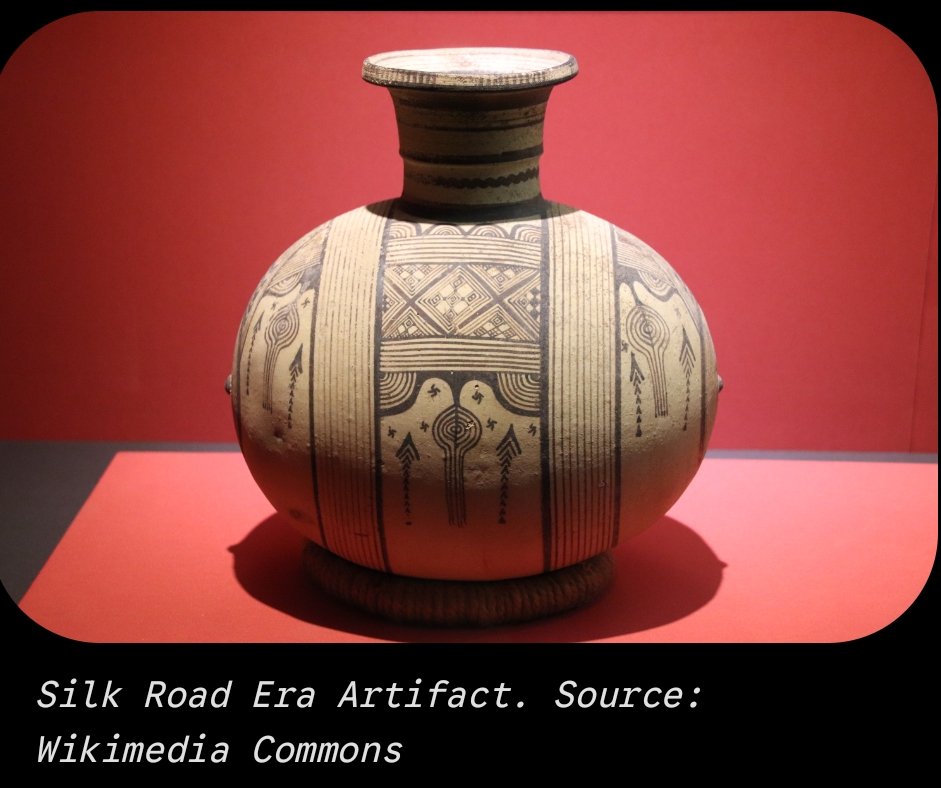
Silk was among the valuable goods transported from China, but the exchanges went far beyond silk. The routes carried luxury goods, food, raw materials and technologies, while also allowing religions, artistic traditions, scientific knowledge and cultural practices to travel between societies.
The ancient city of Chang’an — modern Xi’an — stood at the eastern end of the Chang’an–Tianshan corridor. From there, routes travelled westwards through the Hexi Corridor and towards Central Asia.
That position helped make Xi’an one of the most important historical meeting points between China and the wider world.
A city shaped by 13 dynasties
Xi’an’s importance did not begin with the Silk Road.
The city has more than 3,100 years of history and served as the capital of 13 dynasties in Chinese history, according to China’s State Council website. During the Tang Dynasty, when the city was known as Chang’an, it attracted merchants, envoys and students from different parts of the world.
That long political history left Shaanxi with an extraordinary collection of cultural heritage.
The region tells stories through ancient walls, temples, tombs, museums, pagodas and archaeological sites.
It is also associated with the journeys of Zhang Qian, the Han Dynasty envoy whose missions to Central Asia became an important milestone in the development of contacts between China and the western regions.
The Terracotta Warriors: An army beneath the earth
Perhaps no attraction has put Xi’an more firmly on the global tourism map than the Terracotta Warriors.
The figures were created to accompany Qinshihuang, the First Emperor of China, in the afterlife.
Their discovery began in 1974, when local farmers digging a well accidentally uncovered clay fragments. Archaeological work subsequently revealed the famous underground army near the emperor’s mausoleum.
The Terracotta Warriors are part of the Mausoleum of the First Qin Emperor, which UNESCO added to the World Heritage List in 1987.
The site has since become one of China’s best-known archaeological attractions.
But the Terracotta Warriors are only one chapter of Shaanxi’s story.
Beyond the Terracotta Warriors
Visitors to Shaanxi can encounter a much wider historical landscape.
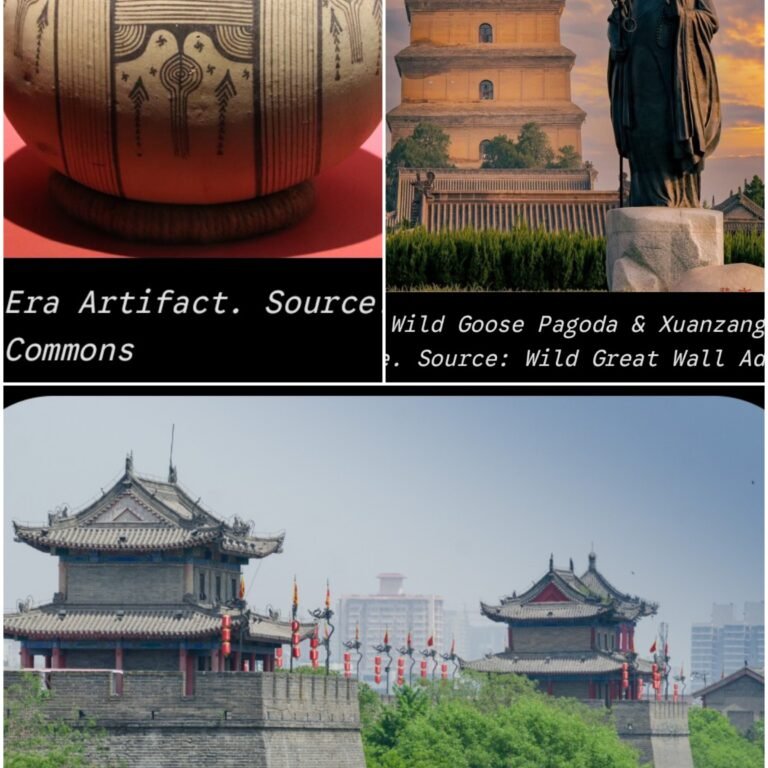
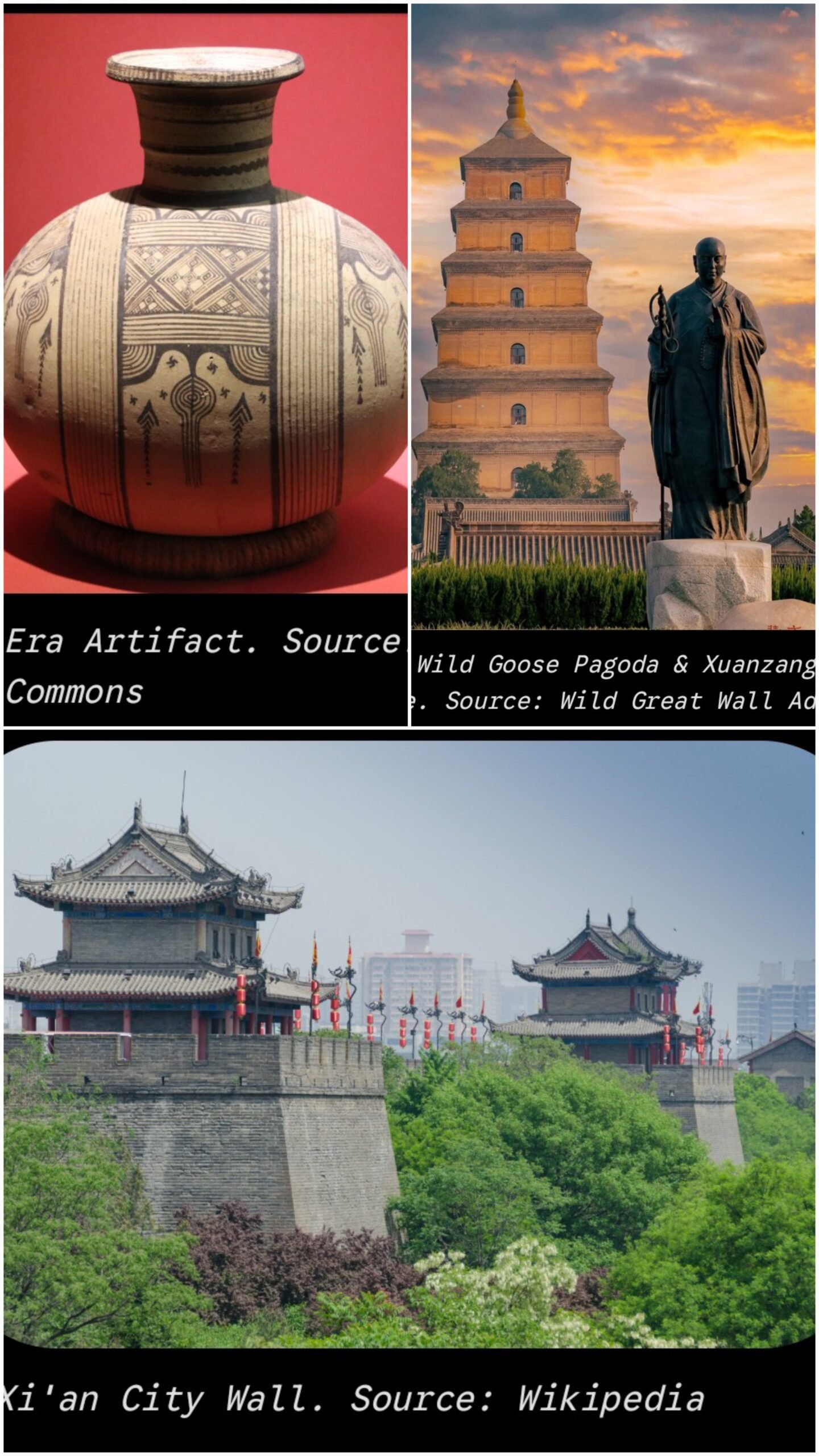
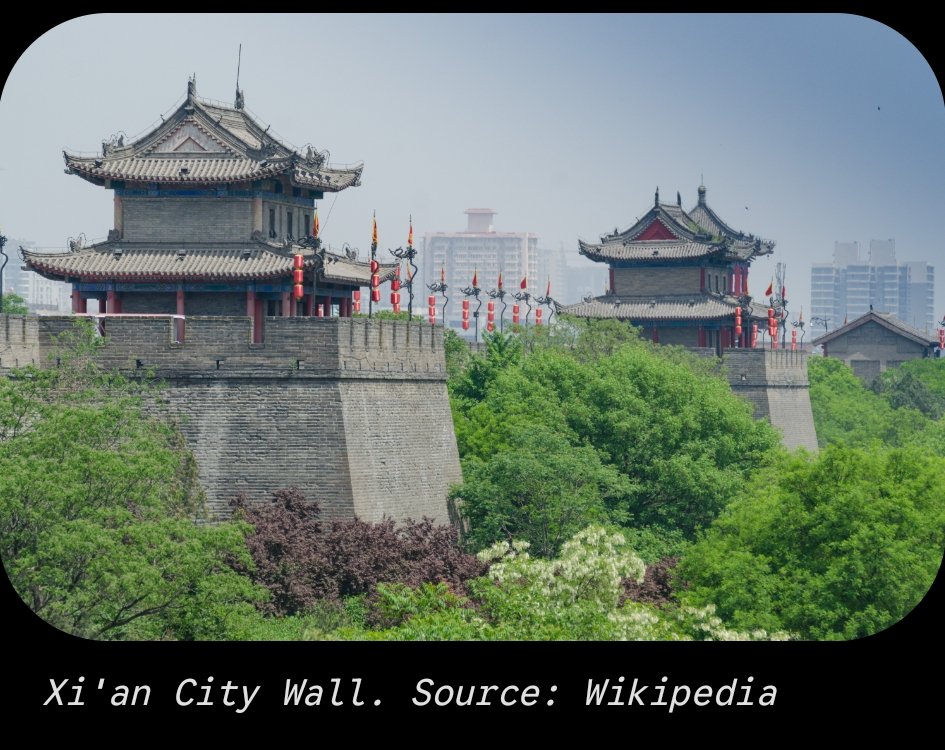
Among its important attractions are Famen Temple, associated with Buddhist heritage; the Xi’an Stele Forest, famous for its collection of stone inscriptions; the ancient city wall; the Giant Wild Goose Pagoda; museums and numerous archaeological sites.
The province’s heritage also reflects the religious and cultural diversity that developed along the ancient Silk Roads.
UNESCO notes that the wider Chang’an–Tianshan corridor contains evidence of Buddhism, Zoroastrianism, Manichaeism, Christianity and Islam, demonstrating how long-distance trade routes also became channels for cultural and religious exchange.
From ancient caravans to modern transport
There is an interesting contrast in Shaanxi today.
The same region once depended on caravans crossing difficult terrain. Today, visitors can reach Xi’an through a modern transportation network built around air travel, railways and highways.
Xi’an has become a major transport and economic centre in western China, while high-speed rail connects the city with other major Chinese destinations.
For international visitors, Xi’an Xianyang International Airport serves the Xi’an–Xianyang metropolitan area, providing an important air connection for the region.
The transformation is striking: routes that once took months or even years to travel can now be crossed in a fraction of the time.
Yet the historical geography remains.
Why Shaanxi matters beyond tourism
The story of Shaanxi is ultimately bigger than sightseeing.
The Silk Roads demonstrate that globalisation is not entirely a modern phenomenon.
Centuries ago, people were already moving across borders in search of trade, knowledge, opportunity and cultural exchange.
They did not travel by modern aircraft or high-speed rail. They travelled through deserts, mountains, valleys and ancient settlements.
Their journeys helped create connections between societies that were geographically distant but increasingly linked through commerce and human interaction.
UNESCO says the Silk Roads contributed to exchanges in trade, religion, scientific knowledge, technology, art and cultural practices across Eurasia.
That makes Shaanxi particularly significant.
Standing in modern Xi’an, visitors are not simply looking at remnants of an ancient Chinese capital. They are looking at a place that formed part of one of history’s great networks of human exchange.
Shaanxi today: History meets modern China
Modern Shaanxi combines this heritage with contemporary tourism, transportation, commerce and technology.
Xi’an’s ancient city walls stand alongside a modern urban landscape. Traditional culture appears alongside modern entertainment, museums and high-speed transportation.
The city has also continued to present its Silk Road heritage to international visitors.
In 2024, China’s State Council described Xi’an as a historic cultural nexus connecting China with the wider world, highlighting its legacy as an ancient Silk Road city.
The result is a destination where the past is not confined to a museum.
It remains part of the city itself.
A journey through China’s connection to the world
For anyone interested in Chinese history, archaeology, culture or international exchange, Shaanxi offers something unusual.
It allows visitors to move through different layers of history — from the Qin Dynasty and the Terracotta Warriors, to the imperial capital of Chang’an, to the Buddhist heritage of Famen Temple and the wider Silk Road story.
And perhaps that is the most powerful lesson of Shaanxi.
The Silk Road was never only about silk.
It was about people.
People who travelled.
People who traded.
People who carried beliefs, knowledge, art and technology across borders.
And in Shaanxi, many of those stories remain visible today.
Shaanxi is therefore not simply a place to visit. It is a place to understand how different parts of the ancient world learned to connect.
Source/Credit:
Background information supplied for this feature was cross-checked with UNESCO World Heritage Centre and China’s State Council/Xinhua reports on Xi’an, the Silk Roads, Shaanxi and the Terracotta Warriors.
Media360Impact | Stories that matter to ordinary Nigerians