
By Gabriel Ameh
The Nigerian Communications Commission (NCC) has praised the Minister of Communications, Innovation and Digital Economy, Dr. Bosun Tijani, for promoting initiatives aimed at equipping young Nigerians — especially girls with digital knowledge and technology skills.
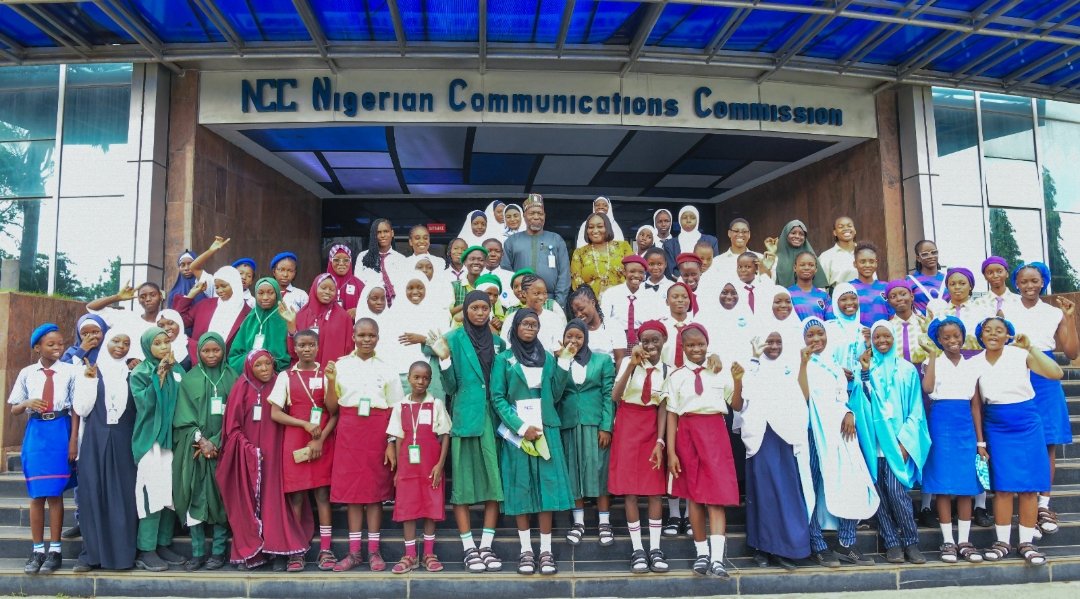
The commendation came as the Commission hosted 185 contestants of the 2026 National Girls in ICT (NG-ICT) Competition on an educational tour of the National Communications Museum in Abuja.
The students, selected from across Nigeria’s six geo-political zones, are participating in the competition designed to encourage digital inclusion and increase girls’ participation in Information and Communication Technology (ICT) and other Science, Technology, Engineering and Mathematics (STEM) fields.
Speaking during the tour, the Executive Vice Chairman of the NCC, Dr. Aminu Maida, represented by the Director of Research and Development, Babagana Digima, described the initiative as a vital step toward improving digital literacy among young Nigerians.

According to him, the museum tour was organised to connect the younger generation with the history and evolution of Nigeria’s telecommunications sector from analogue systems to the modern digital age.
“The idea is to expose young people to the history of communications and inspire their curiosity about technology and innovation. By understanding the past, they can better imagine and shape the future of Nigeria’s digital economy,” he said.
The visit formed part of activities under the National Girls in ICT Programme, an initiative of the Ministry of Communications, Innovation and Digital Economy aimed at bridging the gender gap in the technology sector through mentorship, exposure and digital skills development.
During the excursion, NCC officials guided the students through historical exhibits documenting major milestones in Nigeria’s telecommunications journey.
The students learned about the country’s early communication systems dating back to 1886, including telegraph services that linked Lagos to other parts of West Africa and Europe through submarine cable connections.
They were also introduced to Nigeria’s telecom development after Independence in 1960, when the country had only 18,724 telephone lines serving about 40 million people.
The tour further highlighted the evolution of key institutions such as the former Department of Posts and Telecommunications (P&T), Nigerian External Telecommunications (NET) Limited, and the establishment of Nigerian
Telecommunications Limited (NITEL) in 1985.
Among the historical artefacts displayed at the museum were a 19th-century Post Office Counter, leather mail bags from 1863, telegram machines, teleprinters, cordless PBX systems and early digital card phones.
The NCC said exposing young Nigerians to the history of technological innovation is important in preparing future leaders for the country’s rapidly expanding digital economy.