
By Gabriel Ameh
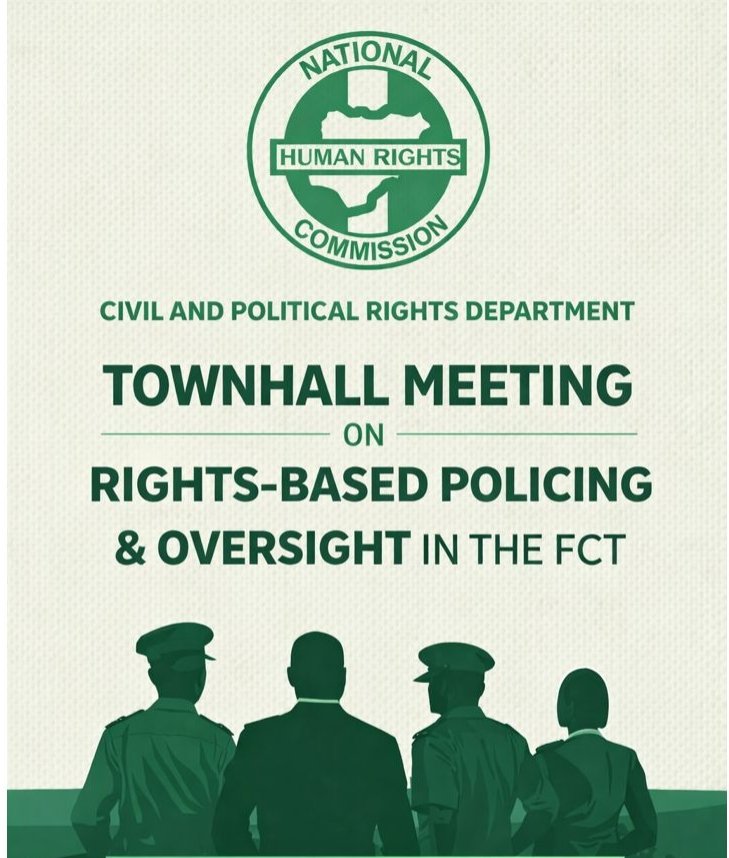
The National Human Rights Commission (NHRC) has convened a strategic town hall meeting for Divisional Police Officers (DPOs) in the Federal Capital Territory (FCT), aimed at strengthening human rights–based policing and reducing cases of abuse.
The Commission emphasized that respect for human rights is not a limitation to policing but a benchmark for professionalism. According to NHRC, when rights are upheld, public confidence improves, cooperation increases, and security outcomes become more effective.
The forum brought together senior officials from the Police Service Commission (PSC), Nigeria Police Force, and NHRC to address recurring operational challenges and ensure alignment with constitutional and international human rights standards.
Speaking on behalf of the Executive Secretary, Dr. Tony Ojukwu, OFR, SAN, the Director of the Civil and Political Rights (CPR) Department, Barr. Adamu Halilu, described DPOs as “frontline commanders of Nigeria’s security architecture and the critical bridge between citizens and safety.”

Dr. Ojukwu referenced the Police Regulations 2025, launched on April 15 by the Minister of Police Affairs with NHRC’s input, describing it as a major reform framework. He said the regulations integrate UN policing standards and provide clear guidelines to reduce violations and improve accountability.
Barr. Halilu noted that the objective of the engagement is to make human rights compliance mandatory across all FCT police divisions. He stressed the importance of strict adherence to the Anti-Torture Act (2017) and the Administration of Criminal Justice Act (ACJA, 2015).
“Non-compliance attracts both personal and institutional liability,” he warned, adding that policing must transition from coercion-based methods to intelligence-led investigations supported by forensic evidence.
Deputy Director of the CPR Department, Barr. Mrs. Charity C. Orvainya, highlighted ACJA provisions on lawful arrest, detention timelines, bail rights, and humane treatment of suspects, describing the law as a “trust instrument” that safeguards justice and accountability.
Another Deputy Director, Mr. Damian Ugwu, raised concerns over increasing torture-related complaints under the 2017 Act and reminded officers of their legal duty to prevent and report violations.
“Rights compliance is not weakness; it is professional strength that legitimizes policing,” he stated.
The Chairman of the Police Service Commission, represented by Mr. Babatunde Dada, Esq., commended NHRC for its leadership and inter-agency collaboration in developing the Police Regulations 2025.
The FCT Commissioner of Police, represented by DCP Unugu Hillary, PhD, reaffirmed the Force’s commitment to reforms and pledged to cascade the training across all police formations in the FCT.