
By Achile Momoh
ABUJA – The National Senior Citizens Centre (NSCC) has called for urgent and coordinated action to end elder abuse in Nigeria, describing the mistreatment of older persons as a serious human rights violation that requires stronger laws, better protection systems, and increased investment in elderly care.
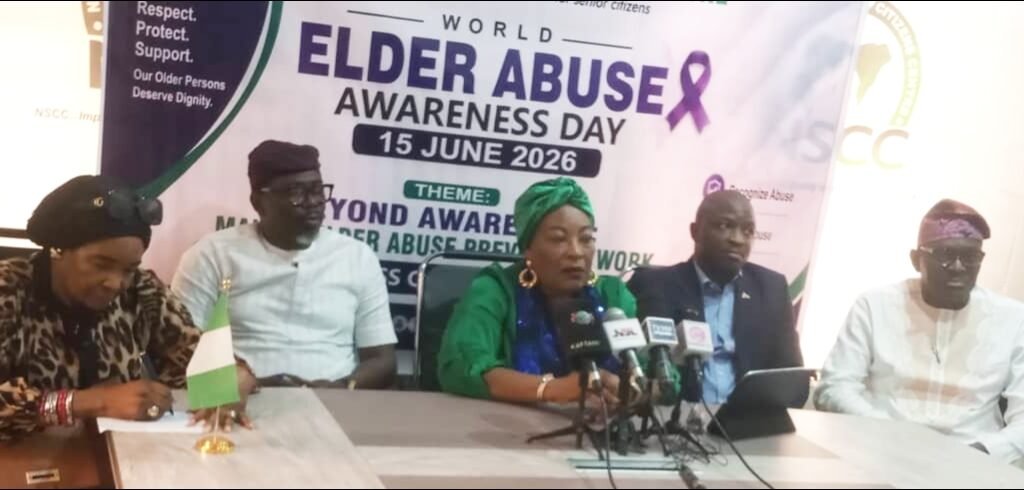
In a statement marking World Elder Abuse Awareness Day 2026, the Director General of NSCC, Hon. Medinat Omobolanle Akinyemi-Obe, said Nigeria must move beyond awareness campaigns and focus on practical measures that prevent abuse and protect the dignity of senior citizens.
Speaking on the theme, “Beyond Awareness: Making Elder Abuse Prevention Work,” Akinyemi-Obe noted that many older Nigerians continue to face physical abuse, neglect, discrimination, financial exploitation, and social exclusion.
According to her, elder abuse in Nigeria goes beyond individual actions and has become a systemic issue, with millions of senior citizens struggling to access healthcare, financial services, social protection, and other essential support systems.
She cited cases of older persons being denied access to loans, excluded from health insurance coverage, abandoned by family members, accused of witchcraft, and deprived of their pensions and property rights.
The NSCC boss stressed that Nigeria cannot achieve meaningful development while neglecting the generation that contributed significantly to nation-building.
To address the challenge, she disclosed that the NSCC is strengthening collaboration with the National Agency for the Prohibition of Trafficking in Persons (NAPTIP), the National Human Rights Commission (NHRC), and the Legal Aid Council of Nigeria to establish a faster and more effective system for reporting and responding to elder abuse cases.
She also revealed that the Centre has trained and certified more than 500 young Nigerians as professional geriatric caregivers under the National Occupational Standards programme, creating employment opportunities while improving care for older persons.
Akinyemi-Obe further highlighted the development of a National Ageing Database aimed at improving data collection and helping authorities identify vulnerable elderly populations across the country.
The NSCC reiterated its support for the Older Persons (Rights and Privileges) Bill, 2025 (HB 2098), currently before the National Assembly. If passed into law, the bill would criminalise age discrimination, provide mandatory health coverage for indigent senior citizens under the National Health Insurance Authority (NHIA), establish standards for senior care facilities and caregivers, and impose penalties on individuals found guilty of elder abuse.
The agency also urged development partners, international organisations, the private sector, and civil society groups to support initiatives aimed at protecting older persons, including investments in healthcare facilities, caregiver training, legal support services, age-friendly infrastructure, and senior citizen welfare programmes.
Calling on Nigerians to speak out against abuse, the NSCC encouraged citizens to report cases involving older persons to relevant authorities, including NAPTIP, the National Human Rights Commission, and the Centre itself.
Akinyemi-Obe maintained that the dignity of any nation is reflected in how it treats its elderly population and called for collective action to ensure that elder abuse prevention moves from awareness to measurable results.
She urged stakeholders across all sectors to work together to build a society where older Nigerians can live with dignity, security, and respect.