

By Gabriel Ameh
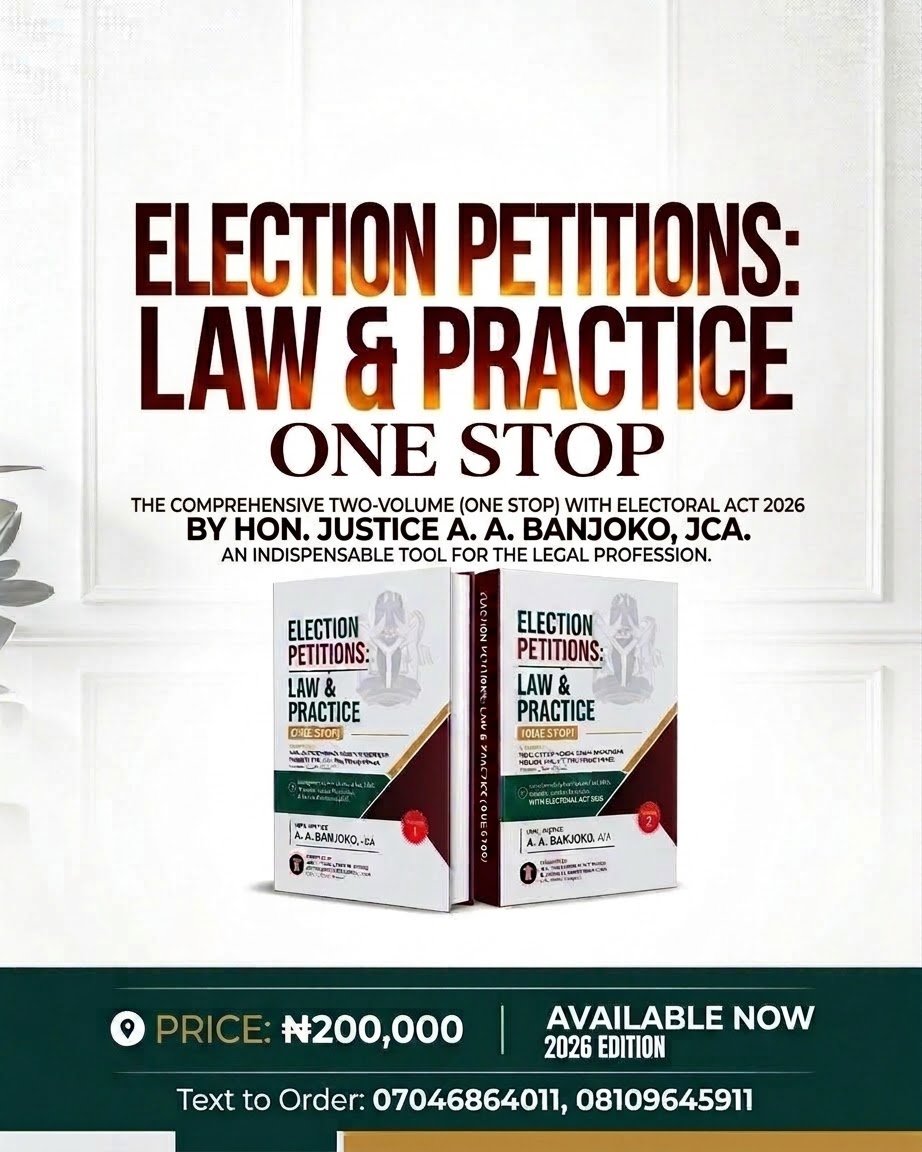
A new two-volume legal publication authored by the Honourable Justice A. A. Banjoko has been described as a significant contribution to Nigeria’s legal literature, particularly in the areas of election petitions and pre-election disputes.
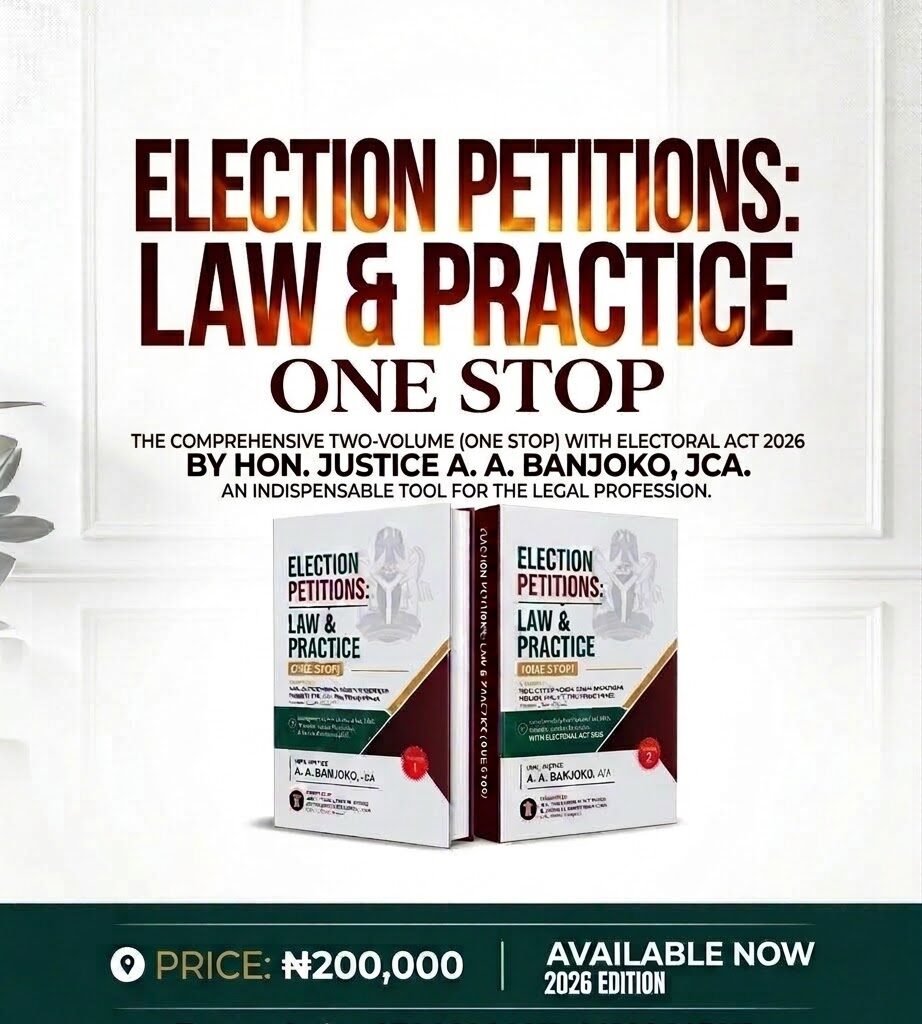
The books, titled Election Petition: Law & Practice (One-Stop), Volumes 1 and 2, provide an extensive examination of the laws, procedures, judicial decisions and legal principles governing electoral disputes in Nigeria.
In an assessment of the publication, Prof. Yemi Akinseye-George, SAN, FNIALS, FCIArb, described the books as timely and valuable resources for legal practitioners, judges, academics and other stakeholders involved in Nigeria’s electoral process.
According to him, the two volumes address some of the most technical aspects of electoral litigation, offering practical guidance on the interpretation and application of electoral laws.
Volume 1, which contains 13 chapters, focuses on pre-election matters. It examines disputes relating to political parties, party primaries, nomination and substitution of candidates, qualification and disqualification, locus standi, jurisdiction and other legal issues that arise before elections.
Volume 2, comprising 14 chapters, focuses on election petitions and the legal grounds for challenging election results.
Its coverage includes substantial non-compliance with electoral laws, corrupt practices, over-voting, improper accreditation, exclusion of lawful votes, electoral malpractice, burden and standard of proof, admissibility of evidence and the procedural requirements for election petition proceedings.
The second volume also examines digital evidence in Chapter 13, reflecting the growing role of technology and electronic materials in resolving contemporary electoral disputes.
A major feature of the publication is its examination of the Electoral Act 2026, including a comparative analysis of the 2022 and 2026 Electoral Acts.
The analysis highlights legislative amendments, new provisions and their potential implications for electoral administration and litigation in Nigeria.
The books also examine notable judicial decisions, including relevant 2026 pronouncements of the Supreme Court and Court of Appeal, providing readers with insights into how courts interpret and apply electoral laws when resolving disputes.
Akinseye-George noted that the strength of the publication lies in its comprehensive coverage, practical approach and accessibility.
He explained that by bringing together legislation, judicial precedents, scholarly opinions and comparative perspectives from other jurisdictions, the two volumes fulfil their One-Stop concept of providing a readily accessible reference for legal research and professional practice.
The publication is expected to serve as a useful resource for judges, election petition tribunals, legal practitioners, Senior Advocates of Nigeria, law students, academics, researchers, political parties, candidates and electoral administrators.
Beyond its academic value, the books address the practical demands of electoral litigation, where a proper understanding of statutory provisions, evidence and judicial precedents can significantly influence the outcome of disputes.
In his concluding assessment, Akinseye-George described the publication as more than an exposition of electoral law, noting its potential contribution to effective legal advocacy, sound judicial decision-making and the advancement of electoral justice in Nigeria.
He recommended the books to stakeholders in the country’s electoral and judicial systems, saying they deserve a place in law libraries, judicial chambers and the offices of legal practitioners.