

By Yu Dunhai, Chinese Ambassador to Nigeria
China has reaffirmed its commitment to strengthening governance, fighting corruption and expanding international cooperation, with Chinese Ambassador to Nigeria, Yu Dunhai, describing internal party reforms as a major driver of the country’s development.
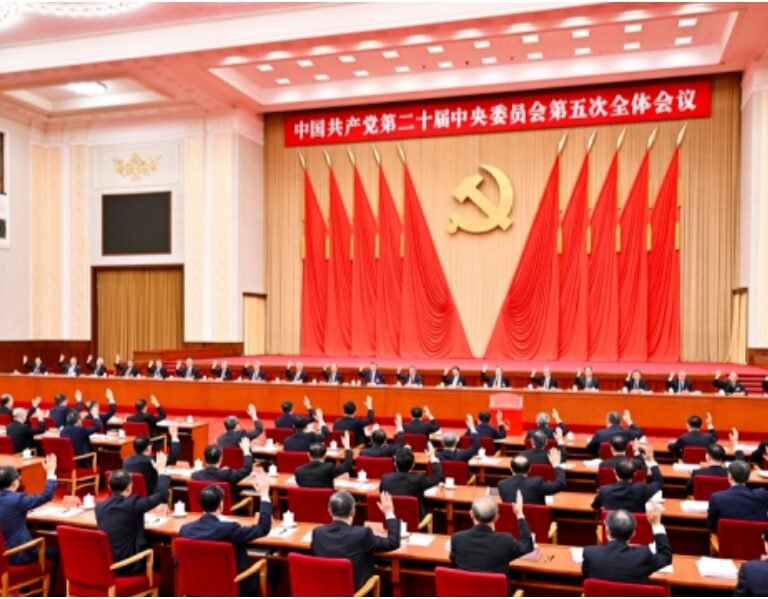
Yu made this position known in an article titled “Leading Chinese Modernization Steadily Forward Through the Party’s Self-Revolution,” following the conclusion of the Fifth Plenary Session of the 20th Central Committee of the Communist Party of China (CPC) in Beijing.
The plenary session, held from October 26 to 29, 2026, adopted a resolution outlining measures to strengthen party discipline, improve governance and sustain efforts towards comprehensive and rigorous self-governance.
According to the ambassador, China’s development experience demonstrates that effective national governance begins with strong internal discipline, accountability and the willingness of political institutions to address their own shortcomings.
He argued that the CPC’s commitment to self-reform and its sustained anti-corruption campaign have strengthened its governance capacity and helped create conditions for economic growth and long-term social stability.
Yu maintained that self-revolution is not merely a political principle but a practical approach to national development, adding that China’s economic transformation, industrial expansion and poverty reduction efforts reflect the outcomes of its governance policies.
He noted that China has developed the world’s largest and most comprehensive industrial system, while its manufacturing value-added has maintained the leading position globally.
The ambassador also highlighted the country’s growing middle-income population, which he put at more than 400 million people, alongside its achievements in addressing extreme poverty.
On China’s global economic role, Yu said the country has contributed approximately 30 per cent of global economic growth for several consecutive years, describing it as an important force in sustaining global economic stability.
He added that China’s commitment to further opening its economy would create opportunities for international trade, investment and cooperation, particularly among developing countries.
Addressing China’s relationship with Africa, the ambassador described the continent as a strategic partner in the pursuit of modernisation and a major force within the Global South.
He said the Forum on China-Africa Cooperation (FOCAC) continues to provide an important platform for strengthening relations, pointing to the 2024 Beijing Summit, where Chinese President Xi Jinping announced 10 partnership actions aimed at supporting modernisation across Africa.
Yu also highlighted China’s implementation of zero-tariff treatment for African countries with which it maintains diplomatic relations, effective May 1, 2026, describing the policy as an opportunity to expand African exports, strengthen trade and support industrial development.
He further disclosed that the Communist Party of China is expanding exchanges with African political parties on governance and public administration, with the aim of promoting mutual learning and institutional cooperation.
Turning to Nigeria, Yu described the country as Africa’s most populous nation and an important driver of the continent’s economic development.
Reflecting on his more than two years as Chinese Ambassador to Nigeria, he said he had observed a strong desire among Nigerians for effective governance, political stability and a development path shaped by the country’s national priorities.
He noted that Nigeria’s efforts to strengthen strategic autonomy, attract foreign investment, expand international trade and promote technological innovation demonstrate its determination to build a sustainable development model suited to its circumstances.
According to him, the relationship between Nigeria and China has entered a new phase of high-quality development under the strategic leadership of President Xi Jinping and President Bola Ahmed Tinubu.
He said both countries were strengthening exchanges on governance, aligning development priorities and expanding practical cooperation across different sectors.
Yu stressed that China does not intend to impose its development model on other countries or attach political conditions to its international partnerships, insisting that every nation should have the freedom to determine its own development direction.
He also reaffirmed China’s commitment to the Global Development Initiative, Global Security Initiative, Global Civilization Initiative and Global Governance Initiative.
The ambassador concluded that China would continue pursuing its modernisation agenda, strengthening internal governance, expanding international cooperation and supporting global peace and development.
He expressed optimism about deeper cooperation with Nigeria and other countries in the Global South, emphasising equality, mutual learning and shared development as foundations for stronger international partnerships.
SOURCE: Yu Dunhai, Chinese Ambassador to Nigeria.