
By Gabriel Ameh
China has renewed its call for stronger international cooperation to accelerate progress toward the United Nations Sustainable Development Goals (SDGs), urging countries to increase development financing, embrace technological innovation, and close widening development gaps.
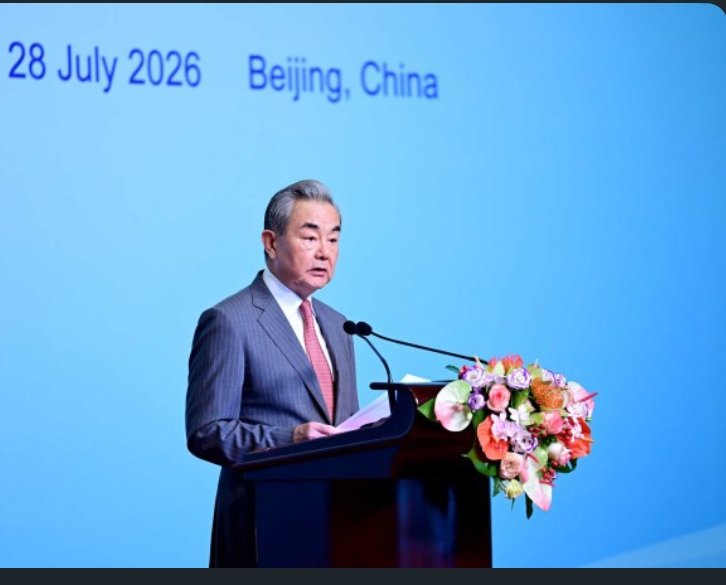
The appeal was made by Chinese Foreign Minister Wang Yi during the High-Level Meeting marking the fifth anniversary of the Global Development Initiative (GDI), a flagship development framework proposed by President Xi Jinping at the 76th Session of the United Nations General Assembly.
The event, jointly organised by China and several United Nations agencies, brought together government officials, development partners and international organisations to review the achievements of the initiative and explore strategies for advancing sustainable development amid growing economic and geopolitical uncertainties.
Speaking at the meeting, Wang said the Global Development Initiative has grown into a major platform for international development cooperation over the past five years, attracting support from more than 130 countries and international organisations.
According to him, nearly 100 countries and regional organisations have entered into cooperation agreements with China under the initiative, reflecting increasing global interest in collaborative development efforts.
Wang added that institutional support for the initiative has continued to expand through platforms such as the Group of Friends of the GDI, which now comprises 88 member states, as well as a United Nations task force involving more than 20 development agencies working to advance the 2030 Agenda for Sustainable Development.
Highlighting China’s financial contributions, the foreign minister disclosed that more than US$23 billion has been mobilised through development funding mechanisms, including the China-UN Peace and Development Fund and the Global Development and South-South Cooperation Fund.
He said the funding has supported over 1,800 community-based livelihood projects and provided vocational and professional training for more than 200,000 people across developing countries.
Wang also highlighted several flagship programmes under the initiative, including China’s Juncao technology for poverty reduction, the Sustainable Development Science Satellite-1 (SDGSAT-1), and the MAZU platform, which provides weather information and disaster early-warning services to developing nations.
According to him, these programmes have benefited communities in more than 120 countries.
Despite the progress recorded, Wang warned that global development continues to face significant setbacks due to armed conflicts, economic instability and widening inequalities between developed and developing nations.
He stressed that restoring development as a priority in international cooperation remains critical to achieving lasting peace, stability and shared prosperity.
To strengthen global development efforts, Wang proposed four key priorities: enhancing international solidarity to promote peace and stability; increasing investment and development financing; expanding cooperation in science, technology and artificial intelligence; and reforming global economic governance to better represent the interests of developing countries.
On emerging technologies, he highlighted the establishment of the World Artificial Intelligence Cooperation Organization (WAICO), launched by China alongside 28 other countries, describing it as a platform aimed at promoting inclusive AI governance and improving access to advanced technologies for developing nations.
Wang also urged developed countries to honour their commitments on development financing while calling for stronger international coordination ahead of discussions on the global development agenda beyond 2030.
Commenting on China’s domestic economy, Wang said the country’s economic resilience remained strong despite global challenges.
He noted that China’s Gross Domestic Product (GDP) grew by 4.7 percent in the first half of 2026, despite global energy shortages and disruptions to international supply chains.
He reaffirmed China’s commitment to deepening cooperation with countries across the Global South and advancing the Global Development Initiative as part of its broader vision of building a more inclusive, equitable and sustainable global development system.