
By Gabriel Ameh
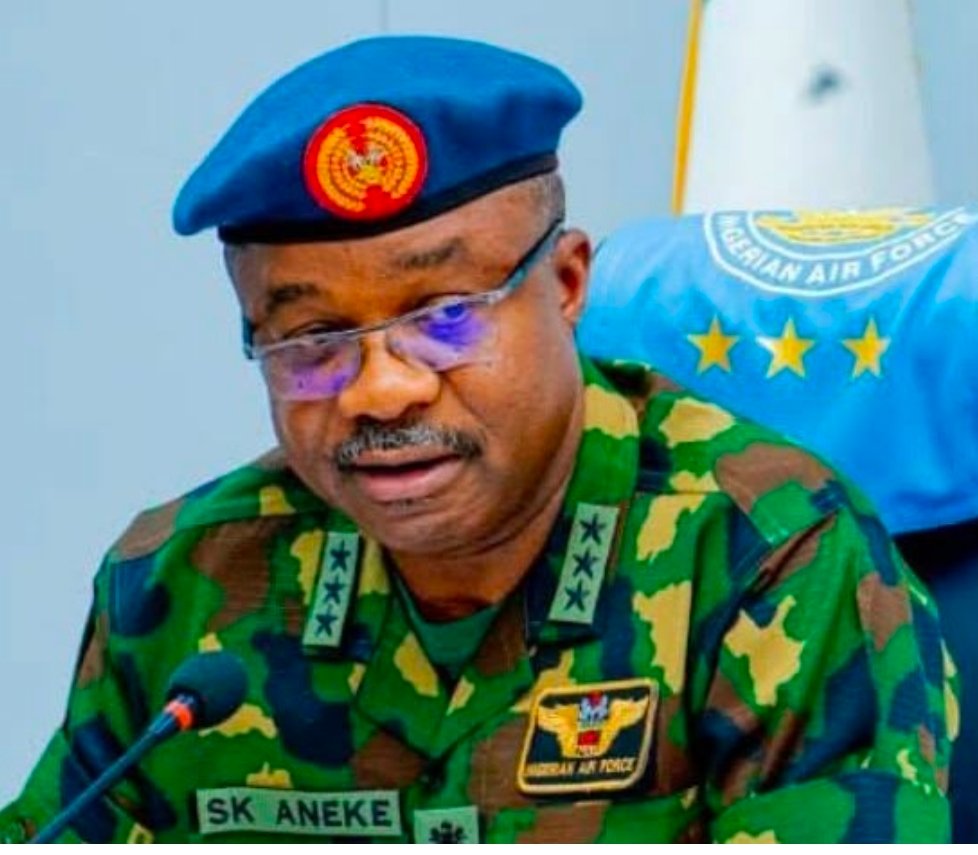
The Chief of the Air Staff (CAS), Air Marshal Sunday Aneke, has said Nigeria can only overcome its increasingly complex security challenges through intelligence-led operations, effective inter-agency collaboration and the coordinated application of decisive air power.
Air Marshal Aneke made the submission while delivering a lecture titled “Air Power and National Security: The Nigerian Air Force in Perspective” to participants of National Defence College (NDC) Course 34 in Abuja on Friday.
According to a statement issued by the Director of Public Relations and Information, Nigerian Air Force, Air Commodore Ehimen Ejodame, the Air Chief noted that Nigeria’s security environment has evolved significantly beyond conventional warfare.
He explained that terrorists, bandits, separatist groups, transnational organised criminal networks and other non-state actors are increasingly exploiting emerging technologies, difficult terrains and civilian populations to evade security forces and undermine national stability.
Aneke stressed that defeating such adaptive threats requires integrated security structures capable of combining intelligence gathered from air, land, maritime, cyber and human sources into a unified operational picture that supports timely and decisive action.
He described air power as a critical force multiplier in national security, noting that it provides the speed, reach, precision and flexibility needed for intelligence gathering, surveillance, reconnaissance, rapid deployment of forces, border protection, maritime security and the defence of critical national infrastructure, while minimising civilian casualties.
The Chief of the Air Staff further emphasised that the growing complexity of Nigeria’s security challenges demands stronger collaboration among the Armed Forces, intelligence agencies and other security institutions.
“No single Service can secure the nation alone,” he said, adding that decisive air power achieves its greatest impact when employed alongside ground forces through intelligence sharing, joint planning and synchronised operations.
Air Marshal Aneke also identified cyber threats, the proliferation of unmanned aerial systems (drones), information warfare, piracy, arms trafficking and other transnational crimes as emerging security concerns confronting the country.
He warned that hostile actors are increasingly exploiting cyberspace and social media platforms to spread disinformation, deepen societal divisions and erode public confidence in government institutions, making strategic communication and cyber resilience essential components of national security.
Reflecting on the Nigerian Air Force’s six decades of operations, the Air Chief said the Service’s experience in defending Nigeria’s sovereignty, supporting regional peace missions and combating internal security threats has underscored the need for indigenous capacity development, innovation, logistics resilience and continuous force modernisation.
He reaffirmed the Nigerian Air Force’s commitment to strengthening its operational capabilities through indigenous innovation, advanced intelligence systems, emerging technologies and strategic partnerships to sustain decisive air power in defence of the nation.
According to him, national security goes beyond protecting Nigeria’s territorial integrity to safeguarding democratic institutions, defending critical infrastructure, promoting economic prosperity and ensuring the safety and well-being of all citizens.
The Air Chief urged participants of the National Defence College Course 34, whom he described as future strategic leaders, to continue promoting joint operations, innovation and inter-agency cooperation as critical pillars for addressing Nigeria’s evolving security challenges.