
By Media360imapct
Nigeria’s democracy continues to expose a deep and uncomfortable contradiction: those who shape political discourse the most are often the least present at the ballot box. While urban elites and politically aware youths dominate conversations about governance, elections are still decided overwhelmingly by grassroots voters who consistently turn out to vote.
As Nigeria moves closer to the 2027 general elections, this participation gap is no longer just an academic concern it is a defining factor that will shape political legitimacy, leadership outcomes, and the credibility of democratic governance.
The Numbers That Define Nigeria’s Democracy.
The 2023 general elections revealed a troubling reality about civic participation.
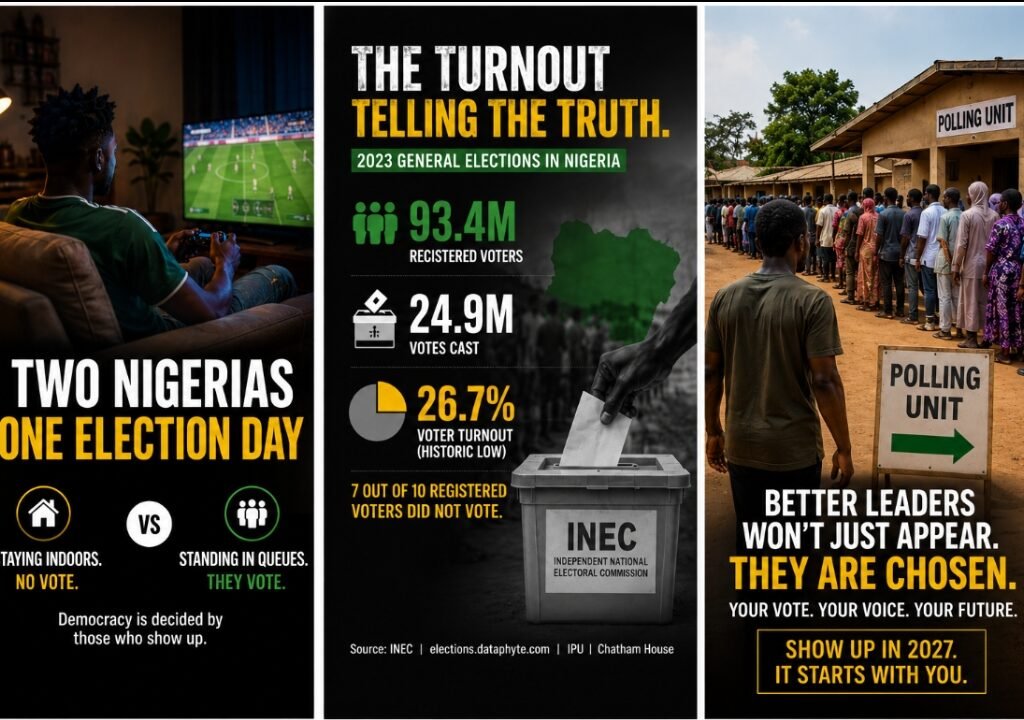
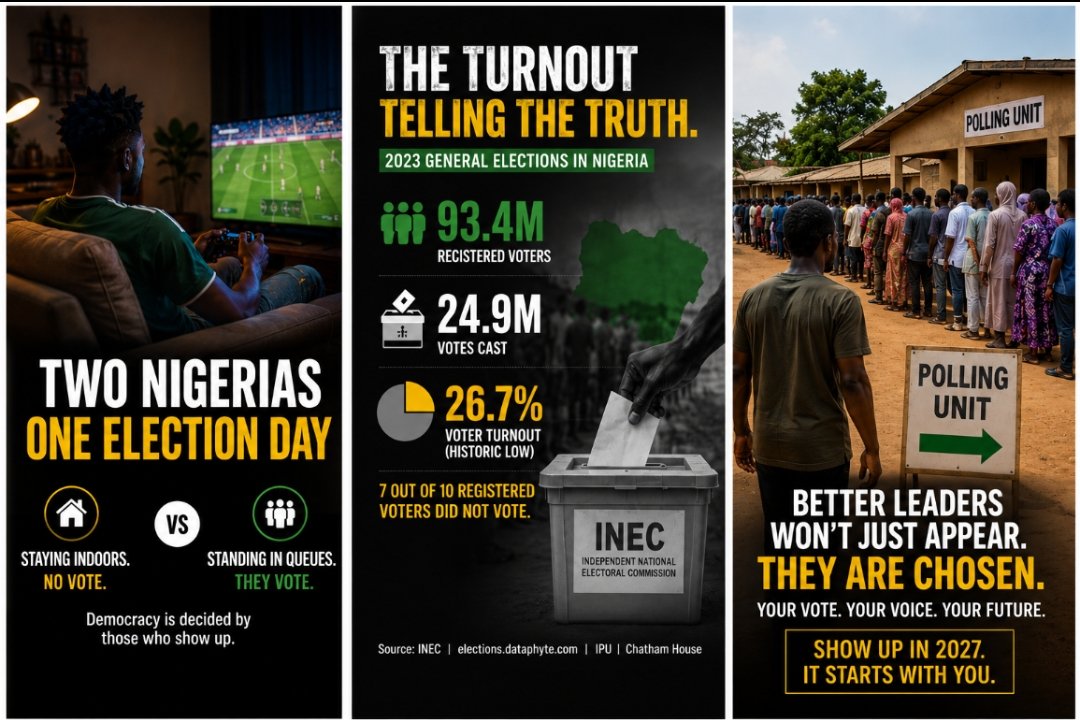
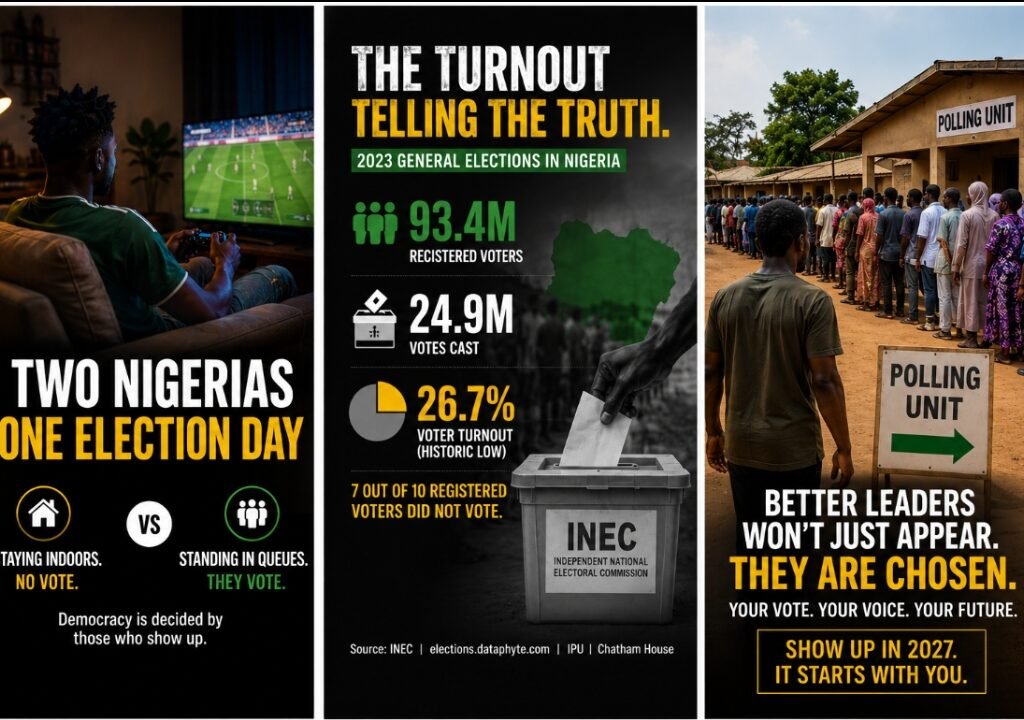
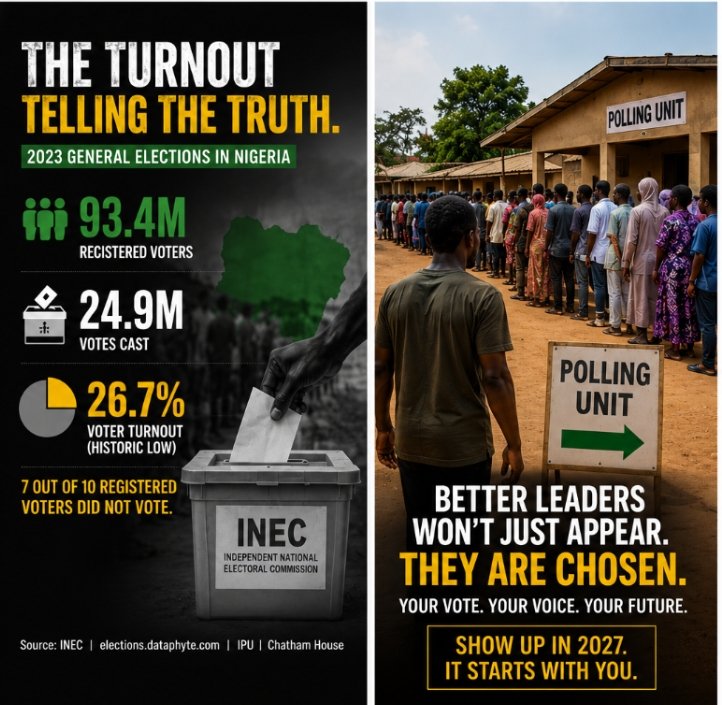
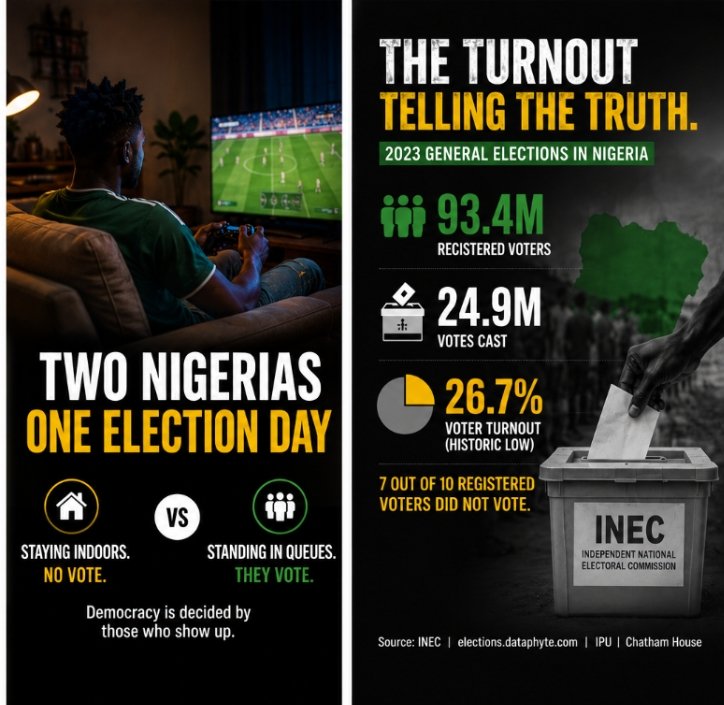
Out of approximately 93.4 million registered voters, only about 24.9 million Nigerians voted, producing a turnout of roughly 26.7%, one of the lowest in Nigeria’s democratic history since 1999.
The Independent National Electoral Commission (INEC) confirmed 93,469,008 registered voters ahead of the election.
This means:
*. Nearly 70% of registered voters did not participate
*. Winning candidates emerged with support from a minority of eligible voters
*. Electoral outcomes were determined by a relatively small, highly active voting population
This structural weakness is not new but it is becoming more consequential as political competition intensifies toward 2027.
Grassroots Nigeria: Where Elections Are Truly Won
Despite growing digital political awareness, Nigerian elections remain fundamentally grassroots-driven.
Rural and peri-urban communities consistently record stronger turnout patterns than many urban centers. Political parties understand this reality well, which is why election strategies often prioritize:
i. Ward-level political structures
ii. Community mobilization networks
iii. Religious and traditional leadership influence
iv. Local vote brokers and grassroots coordinators
In practice, elections are rarely decided in media debates or online activism spaces they are decided in polling units, communities, and local strongholds where voter turnout is consistent and organized.
The Elite and Youth Participation Gap
A defining contradiction in Nigeria’s electoral system is the low turnout among the same groups that are most vocal about governance:
*. Urban professionals
*. Educated middle class
*. Politically active youths in cities
These groups often dominate political conversations but remain underrepresented during elections.
Key reasons include:
*. Logistical challenges, especially for voters registered outside their current residence
*. Distrust in electoral credibility, reinforced by disputes over past elections
*. Security concerns, especially in high-risk or politically tense areas
*. Civic disengagement, where voting is deprioritized compared to personal life or economic
The controversies surrounding the 2023 electoral process, including debates on result transmission and transparency, further deepened skepticism among urban voters.
On Election Day: Indoor Comfort vs Civic Responsibility
On election days in Nigeria, a visible contradiction unfolds across cities and communities. While polling units in rural and peri-urban areas record steady turnout, many urban neighborhoods tell a different story quieter streets, but not necessarily filled with voters.
Instead, a significant number of young people and even members of the middle and upper classes often remain indoors. Some spend the day streaming movies, engaging in online entertainment, playing video games, or simply resting. Others take advantage of the public holiday atmosphere to engage in recreational activities, including visiting friends, social gatherings, or informal sporting activities such as football in open fields and community spaces.
This pattern is not limited to youths alone. Sections of the urban elite professionals, entrepreneurs, and educated voters are also part of this quiet absenteeism.
For some, election day becomes less about civic duty and more about personal downtime or safety avoidance.
Meanwhile, in many communities across Nigeria, grassroots voters move early to polling units, sometimes traveling long distances or waiting in queues under difficult conditions. For them, voting remains a deeply embedded civic ritual and a direct pathway to political relevance.
This contrast highlights a growing democratic imbalance: participation is no longer uniform across social classes. Those most active in political commentary are often not the ones most active at the polling units.
The result is a system where electoral outcomes are shaped not by the most vocal or most educated segments of society, but by those who consistently show up regardless of inconvenience, risk, or comfort.
2027 Elections: The Turning Point or Another Cycle of Apathy?
As Nigeria approaches the 2027 general elections, the same structural weaknesses risk repeating themselves unless deliberate reforms and civic behavioural shifts occur.
If current patterns persist:
i. Grassroots voters will continue to dominate outcomes
ii.Urban and elite dissatisfaction will remain politically ineffective
iii. Electoral legitimacy debates may intensify
iv.Youth political energy may remain expressive but not transformative
The question is no longer whether Nigerians care about governance but whether they are willing to translate that concern into electoral participation.
What Must Change Before 2027: Practical Solutions
Improving participation requires both institutional reform and civic behavioural change.
i Stronger voter mobility systems
Many eligible voters are excluded because they are not physically present in their registration locations. Nigeria urgently needs:
ii..Expanded absentee or transfer-friendly voting systems
Improved voter relocation processes ahead of elections
2. Civic education targeting urban youth and elites
There is a growing disconnect between political awareness and electoral participation. Civic education must:
i. Target universities, workplaces, and professional networks
ii. Reframe voting as direct civic power, not symbolic action
3. Security assurance for voters
Perceived insecurity remains a major deterrent. Strengthening:
i.Election-day policing
ii.Rapid response frameworks
iii.Community-level protection mechanisms will be critical for confidence building.
4. Trust rebuilding in electoral systems
Institutional credibility is central to turnout. The Independent National Electoral Commission (INEC) must continue strengthening:
i.Transparency in result collation
ii.Communication clarity during elections
iii.Technology reliability and auditability
5. Youth engagement beyond activism
Nigeria’s youth population is politically expressive but electorally inconsistent. Bridging this gap requires:
i.Linking activism to voter mobilization
ii.Encouraging peer-to-peer voter participation campaigns
iii. Normalizing voting as part of youth identity (including social culture, sports communities, and digital spaces)
Conclusion: Democracy Reflects Who Shows Up.
Nigeria’s electoral system is not defined only by those who speak the loudest but by those who consistently participate.
The 2023 elections proved this once again: with turnout at just over a quarter of registered voters, governance outcomes reflected the preferences of a highly active minority.
As 2027 approaches, Nigeria faces a defining question:
Will political awareness finally translate into political participation or will democracy continue to be shaped by those who show up while others stay indoors?
Because in the end, elections do not reward opinions.
They reward participation.