
By Gabriel Ameh
ABUJA — The Nigeria Tobacco Control Community, a coalition of more than 100 civil society, health advocacy and public-interest organisations, has called for the recall of the consolidated National Tobacco Control Act (Amendment) Bill 2025.
The coalition said some provisions of the proposed legislation could weaken existing public-health safeguards and create regulatory gaps in the control of tobacco and nicotine products.
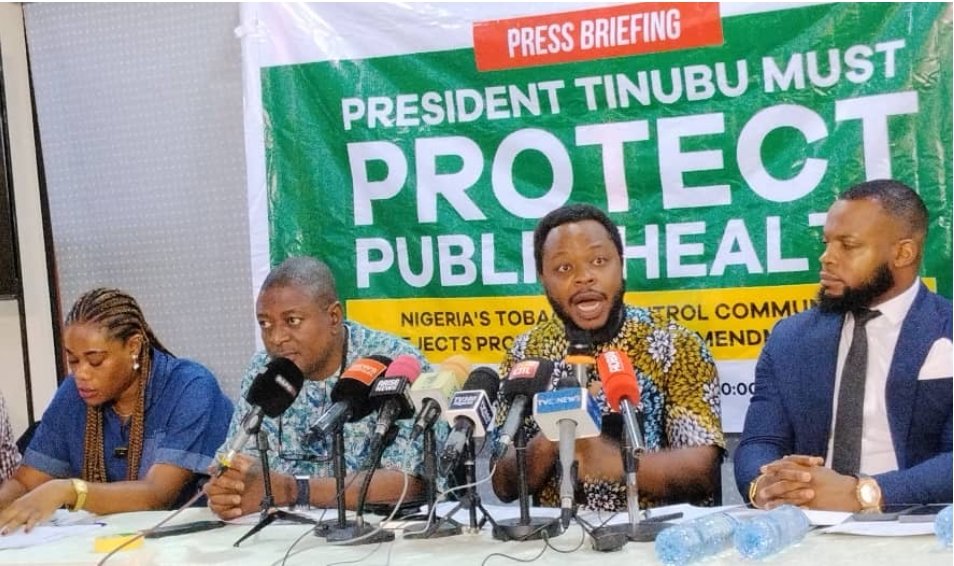
The groups made their position known at a press briefing in Abuja, where Executive Director of Corporate Accountability and Public Participation Africa (CAPPA), Akinbode Oluwafemi, spoke on behalf of the coalition.
Oluwafemi said the coalition supported efforts to update the 2015 National Tobacco Control Act and its 2019 Regulations to address emerging nicotine products.
He, however, cautioned that any amendment should strengthen rather than weaken regulation of products such as vapes, heated tobacco products and nicotine pouches.
The coalition acknowledged some provisions of the bill that it described as positive, including the proposed extension of smoke-free zones to within 30 metres of schools and health facilities, as well as the inclusion of the Nigeria Police Force and Ministry of Youth Development in the National Tobacco Control Committee.
It nevertheless raised concerns about several other provisions contained in the proposed amendment.
Concerns Over Emerging Nicotine Products
The coalition questioned the proposed introduction of “tobacco harm reduction objectives”, arguing that the concept could potentially be used to support less stringent regulation of emerging nicotine products.
It also objected to the proposed classification of heated tobacco products as non-combustible products, arguing that they still contain tobacco and should remain subject to comprehensive tobacco-control measures.
The groups further raised concerns about provisions that could allow advertising of non-combustible products in adult publications, at points of sale and on online platforms.
According to the coalition, a proposed definition allowing publications with up to 50 per cent underage readership to qualify as “adult” publications could expose children and adolescents to tobacco and nicotine marketing.
Oluwafemi also expressed concern over provisions that could permit online sales, remote ordering and mail or courier delivery of non-combustible nicotine products.
He questioned whether existing age-verification systems would be sufficient to prevent minors from accessing such products.
Health Warnings and Product Sampling
Also speaking at the briefing, In-Country Coordinator of the Campaign for Tobacco-Free Kids (CTFK), Michael Olaniyan, highlighted other provisions the coalition wants reviewed.
These include proposals that could permit indoor vaping for product sampling, allow sponsorship of cultural and recreational events, introduce reduced pack sizes for cigars and provide what the coalition described as less stringent health-warning requirements for novel nicotine products.
Olaniyan also raised concerns about provisions that could allow manufacturers to generate and internally approve their own safety dossiers.
He further questioned a provision that would give the Minister of Health broad powers to exempt products from certain provisions of the law on grounds of “public interest”.
Groups Demand Transparent Review
The coalition called on the National Assembly to recall the consolidated amendment bill and subject it to what it described as a transparent, public-health-led review.
It also requested the publication of committee reports, voting records and stakeholder submissions that informed the provisions under contention.
Members of the Nigeria Tobacco Control Alliance (NTCA) urged the Federal Ministry of Health and Social Welfare to publicly clarify its position on the proposed legislation.
They further called on the ministry to seek the recall of the bill if sufficient consultation had not taken place.
The groups also urged President Bola Ahmed Tinubu not to assent to the legislation if it reaches his desk in its current form.
Assistant Executive Director of CAPPA, Zikora Ibeh, urged the President to consider whether the proposed legislation aligns with the public-health objectives of his administration’s Renewed Hope Agenda.
Ibeh said Nigeria needed what she described as a strong, product-neutral tobacco and nicotine control framework capable of addressing emerging products without compromising existing health protections.
She called for effective restrictions on advertising, sponsorship, product sampling, retail display and remote sales, while maintaining public health as a central consideration in tobacco-control policy.
Coalition Considers Further Action
Responding to questions from journalists, Oluwafemi said the coalition was considering available legal and institutional avenues to advance its position on the bill.
He said the coalition would formally write to both chambers of the National Assembly to present its concerns and seek reconsideration of provisions it believes could have public-health implications.
The coalition maintained that any amendment to Nigeria’s tobacco-control framework should be preceded by broad stakeholder consultation and should balance legitimate policy considerations with the need to protect public health.