


By Emeka Uga | Abuja
Civil society organisations (CSOs) and other stakeholders have called on the Nigerian National Petroleum Company Limited (NNPC) to take a leading role in Nigeria’s transition to cleaner energy, warning that the country’s ambition to achieve net-zero emissions by 2060 will require stronger institutional commitment and coordinated action.
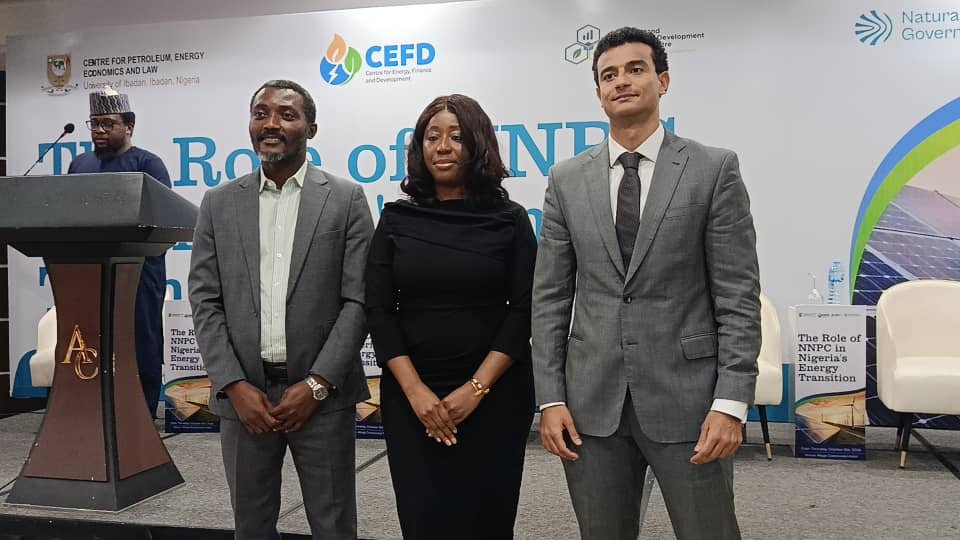
The call was made at a conference in Abuja themed “The Role of NNPC in Nigeria’s Energy Transition,” which brought together representatives of government, NNPC, civil society organisations and the policy community to examine the company’s capacity to support the transition and the conditions required for it to succeed.
The conference was organised by the Centre for Petroleum, Energy Economics and Law (CPEEL), the Centre for Energy, Finance and Development (CEFD), the Inclusive and Sustainable Development Research Center (ISDRC) and the Natural Resource Governance Institute (NRGI).
Nigeria launched its Energy Transition Plan (ETP) in August 2022 as a strategy for achieving net-zero emissions by 2060. The plan identifies five key sectors for emissions reduction: power, cooking, oil and gas, transport, and industry.
Speaking at the conference, Tengi George-Ikoli, Nigeria Country Manager of NRGI, described the energy transition as non-negotiable and stressed that NNPC’s involvement would be critical to achieving the country’s objectives.
“For Nigeria, NNPC plays a very pivotal role. A transition that does not include NNPC is unlikely to succeed,” she said.
George-Ikoli noted that national oil companies across the world were adopting different approaches to the energy transition, ranging from partial diversification and broader business transformation to changes in their traditional oil and gas operations.

She called for a transition pathway that reflects Nigeria’s national priorities while addressing the environmental, economic and social consequences of continued petroleum production.
She also raised concerns about the challenges facing Nigeria’s oil sector, which remains central to the country’s economy, and stressed the need for stronger action from key stakeholders.
On natural gas, George-Ikoli cautioned that expanding its use as a transition fuel could create environmental and public health risks without adequate safeguards.
She further highlighted the need to address liabilities arising from the withdrawal of international oil companies from oil and gas assets, particularly where host communities could bear the consequences.
NNPC’s role in clean energy investment
Participants examined potential areas for NNPC’s involvement in the energy transition, including power-sector development, clean energy investments and emerging low-carbon value chains.
Discussions also focused on defining the limits of NNPC’s responsibilities alongside those of other government institutions and private-sector players.
Stakeholders emphasised the importance of credible financing arrangements, sound corporate governance and transparent accountability mechanisms to ensure that diversification efforts are commercially viable and contribute to Nigeria’s wider development goals.
The discussions also highlighted the importance of establishing clear timelines and an implementation framework for reducing emissions across the five priority sectors identified in the Energy Transition Plan.
As Nigeria pursues its net-zero ambition, NNPC faces the challenge of balancing its commercial responsibilities in the petroleum industry with the need to support investments in natural gas and cleaner energy infrastructure.
Stakeholders seek a practical transition pathway
Other speakers at the conference included Chinedu Igwe, Head of Sustainability at NNPC Limited; Lanre Babalola, Chairman of the Presidential Task Force on Power, Nigeria; Patrick Stephenson, Ghana Country Manager at NRGI; Nicolas Lippolis, Founder and Executive Director of the Centre for Energy, Finance and Development; and Oluwasola Omoju of the Inclusive and Sustainable Development Research Center.
The conference reinforced the need for a coordinated approach to Nigeria’s energy transition, with stakeholders expected to balance emissions reduction, energy access, economic development and environmental protection.
For Nigeria to achieve its 2060 target, the challenge will be to translate policy commitments into measurable action, backed by clear responsibilities, credible investments and effective accountability across the energy sector.
Credit: Emeka Uga