

By Gabriel Ameh
ABUJA | MEDIA360IMPACT
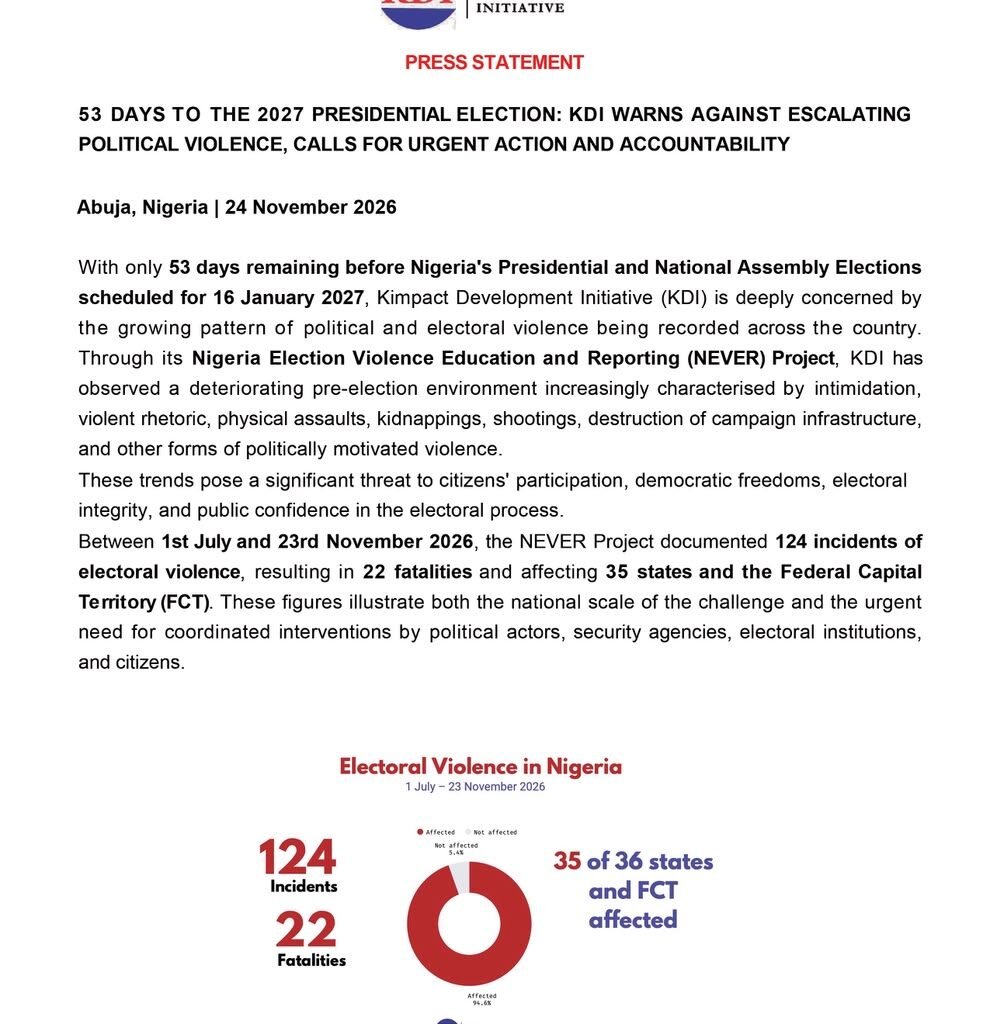
The Kimpact Development Initiative (KDI) has raised concerns over the growing wave of political violence across Nigeria, reporting 124 incidents and 22 deaths in 35 states and the Federal Capital Territory (FCT) ahead of the 2027 general elections.
The organisation disclosed this in a statement issued on November 24, 2026, through its Nigeria Election Violence Education and Reporting (NEVER) Project, warning that rising attacks, intimidation and political hostility could threaten citizens’ safety and undermine the credibility of the forthcoming elections.
According to KDI, its monitoring covered the period between July 1 and November 23, 2026, documenting incidents ranging from physical assaults and shootings to kidnappings, destruction of campaign materials and other politically motivated attacks.
The organisation said the growing violence poses a serious threat to citizens’ democratic rights, freedom of participation and confidence in the electoral process.
Electoral Violence Rises as Campaigns Intensify
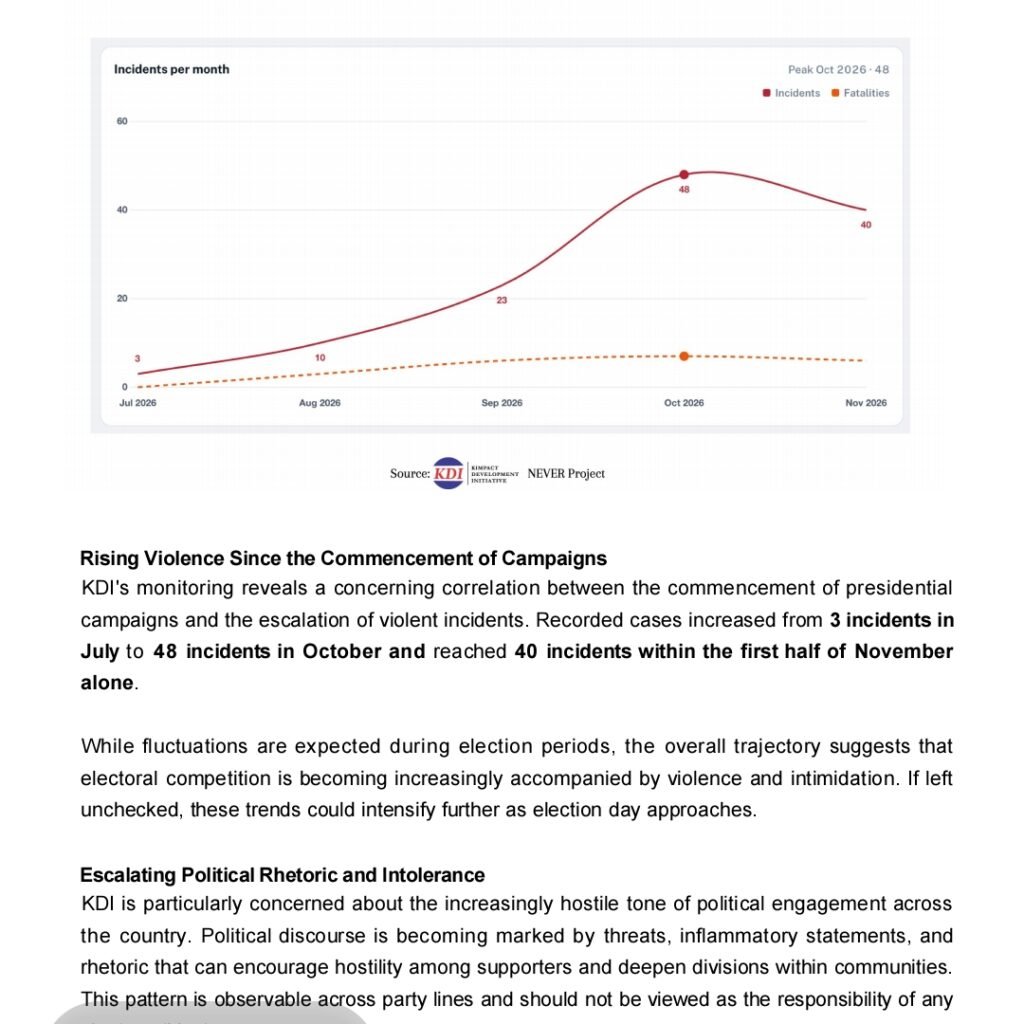
KDI’s findings indicate a sharp increase in electoral violence as political activities gained momentum.
The organisation recorded three incidents in July, compared with 48 in October. Another 40 incidents were documented within the first half of November alone.
KDI warned that the rising trend could worsen as the January 16, 2027, Presidential and National Assembly elections approach if political actors and security agencies fail to take preventive action.
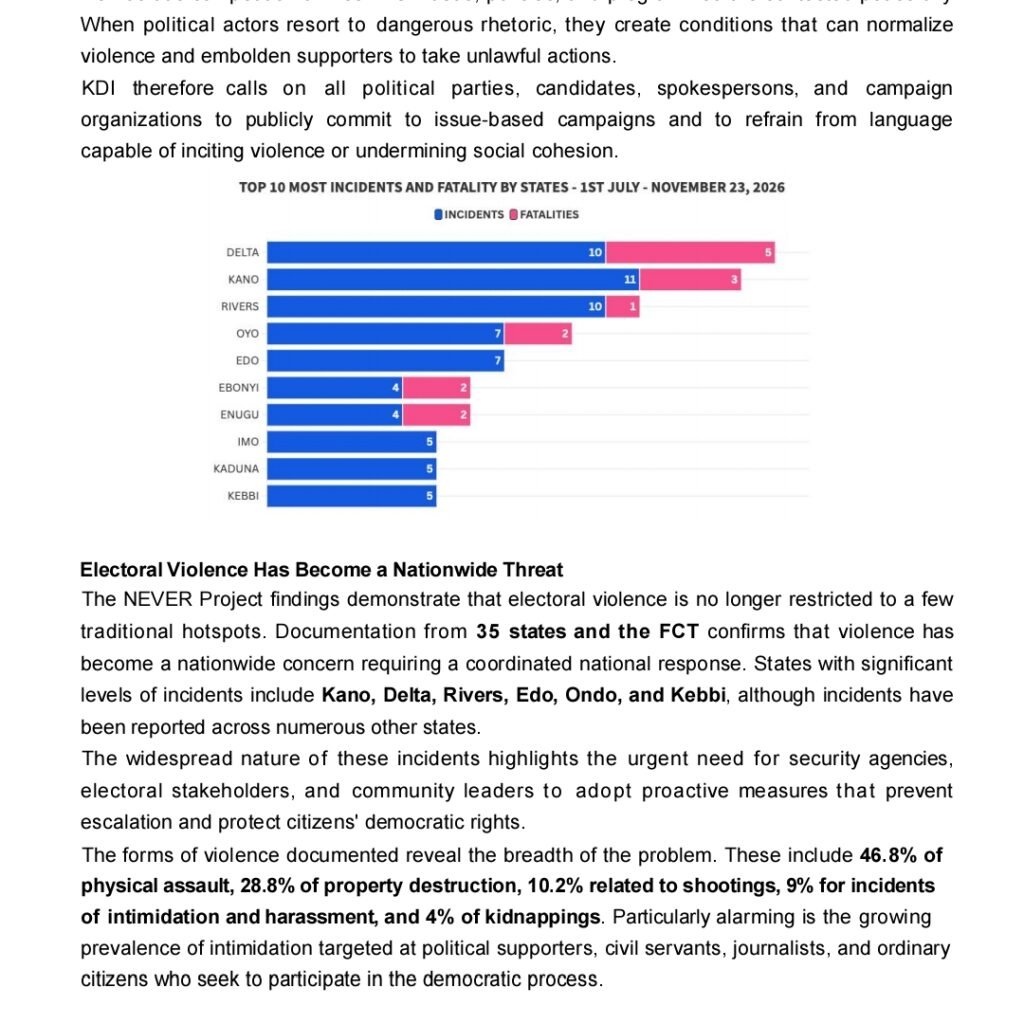
It noted that electoral violence was no longer limited to traditionally identified hotspots, with significant incidents reported in Kano, Delta, Rivers, Edo, Ondo and Kebbi states, among other locations.
The organisation said the spread of violence across 35 states and the FCT calls for a coordinated national response involving political parties, security agencies, electoral institutions and community leaders.
Physical Assaults Account for the Largest Share of Attacks
Breaking down the reported incidents, KDI identified physical assaults as the most common form of electoral violence, accounting for 46.8 per cent of documented cases.
Destruction of property accounted for 28.8 per cent, while shootings represented 10.2 per cent. Intimidation and harassment made up nine per cent, while kidnappings accounted for four per cent.
The organisation expressed particular concern over threats and intimidation targeting political supporters, civil servants, journalists and ordinary citizens seeking to participate in the electoral process.
It warned that such attacks could discourage citizens from exercising their democratic rights freely.
KDI Raises Concern Over Political Rhetoric
Beyond physical attacks, KDI expressed concern over the increasingly hostile language used by political actors and their supporters.
It said political engagement was becoming characterised by threats, inflammatory statements and rhetoric capable of encouraging hostility and deepening divisions within communities.
The organisation stressed that the problem cut across political parties and should not be blamed on any single political group.
It urged political parties, candidates, spokespersons and campaign organisations to focus on policies and issues rather than inflammatory statements capable of provoking violence.
According to KDI, political leaders must also take responsibility for the conduct of their campaign structures and supporters by discouraging unlawful behaviour and sanctioning those involved in violence.
Political Party Members Linked to Most Recorded Incidents
The NEVER Project findings identified political party members and affiliated groups as perpetrators in 82.3 per cent of documented violence incidents.
Political party members and affiliated groups were also identified as victims in 86.5 per cent of the recorded cases.
KDI said the findings highlight the responsibility of political parties and candidates to exercise proper control over their supporters, campaign organisations and mobilisation networks.
The organisation also raised concerns about political intolerance, including reported restrictions on opposition activities, alleged abuse of administrative authority and unequal opportunities for political participation and campaigning.
It warned that such practices could increase tensions and undermine democratic competition.
KDI Questions Accountability for Electoral Violence
The organisation also expressed concern over what it described as a persistent gap between arrests and actual prosecution of people linked to electoral violence.
According to KDI, several arrests connected to political violence have been publicly reported across different states since January 2026.
However, it said it had not identified publicly available evidence of corresponding prosecutions or convictions in many of the cases.
KDI warned that the absence of visible accountability could weaken public confidence in law enforcement and encourage perpetrators to believe they can engage in political violence without facing legal consequences.
It called on law enforcement agencies, prosecutorial authorities and the judiciary to ensure that reported cases are investigated promptly and perpetrators prosecuted in accordance with the law.
Security Agencies, INEC Urged to Act Before Election Day
With the elections approaching, KDI warned that relying mainly on security deployments on election day would not be enough to prevent further violence.
It called for stronger early-warning systems, rapid responses to threats, community engagement and effective enforcement of electoral laws before polling begins.
The organisation urged political parties and candidates to publicly commit to peaceful campaigns and take disciplinary action against supporters involved in violence.
It also called on security agencies to strengthen preventive deployments and enforce the law impartially, while urging the Independent National Electoral Commission (INEC) and other electoral stakeholders to intensify voter education and conflict prevention efforts.
Civil society organisations, religious institutions, traditional leaders and the media were encouraged to promote tolerance and responsible political participation.
KDI also appealed to Nigerians to reject political violence, avoid being manipulated into acts of intimidation and report threats or attacks through appropriate channels.
‘Democracy Must Not Be Decided by Violence’
KDI stressed that every Nigerian must be able to participate in the electoral process without fear of intimidation, coercion, violence or reprisals.
It maintained that election outcomes should reflect the free choices of voters rather than threats, force or political intimidation.
The organisation warned that the signs of escalating electoral violence were already visible and that failure to address them could place additional pressure on security agencies and threaten the peaceful conduct of the 2027 elections.
It called for collective action by political leaders, public institutions and citizens to protect Nigeria’s democratic gains.
KDI maintained that preventing electoral violence must begin before election day, stressing that the responsibility for peaceful elections rests with everyone involved in the democratic process.