
By Gabriel Ameh
Nigeria’s internet challenge is no longer simply about having enough mobile towers.
Increasingly, the infrastructure underneath the roads — particularly fibre-optic cables, ducts and other network facilities — is becoming just as important to how Nigerians experience broadband.
This is where the Nigerian Communications Commission (NCC)’s Dig Once Policy comes in.
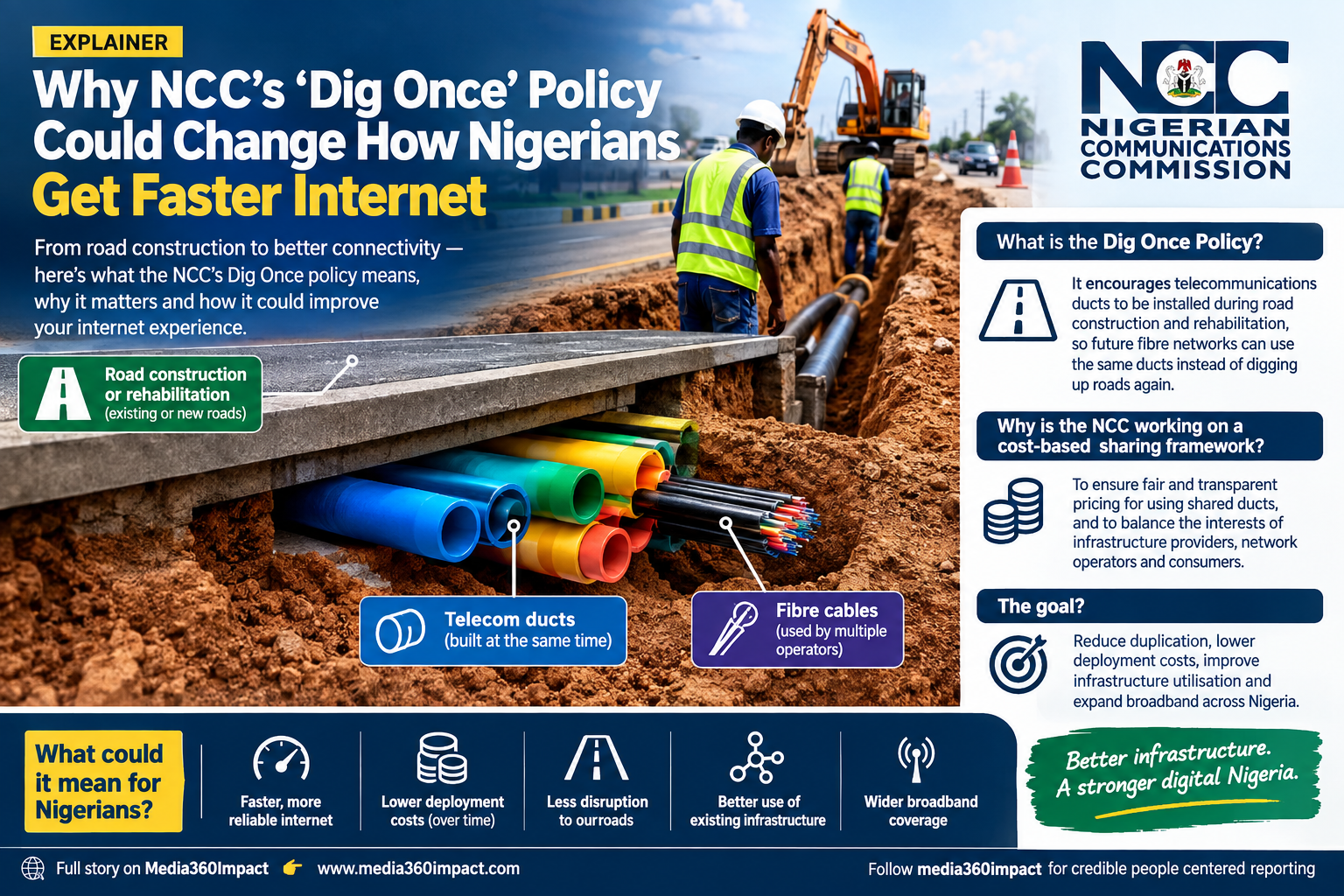
The policy is designed to encourage telecommunications ducts to be installed during road construction and rehabilitation projects, creating pathways that can later be used for fibre-optic deployment.
In July 2026, the NCC said it was developing a cost-based pricing framework for sharing underground ducts built under the policy.
The Commission said the framework is intended to encourage infrastructure sharing, improve the use of existing assets, reduce broadband deployment costs and facilitate the expansion of telecommunications infrastructure across Nigeria.
What exactly is the Dig Once Policy?
In simple terms, the idea is:
If a road is already being opened for construction or rehabilitation, telecommunications infrastructure should be planned into the work instead of waiting for another project to dig up the same road later.
Underground ducts can be installed alongside the road infrastructure.

Telecommunications and fibre operators can subsequently use those ducts to deploy cables.
This could reduce the need for repeated excavation of roads whenever another network operator wants to extend its fibre infrastructure.
According to the NCC, the policy is aimed at encouraging coordinated infrastructure deployment and avoiding unnecessary road excavation.
Why does this matter to ordinary internet users?
A large part of modern telecommunications depends on fibre infrastructure.
Mobile networks may connect a customer’s phone to a nearby base station, but that connection still needs a wider network behind it to carry data to and from the internet.
That means the quality and availability of broadband are influenced not only by the mobile tower but also by the fibre and other infrastructure connecting different parts of the network.
The NCC’s own quality-of-service system collects network performance information from operators’ Network Operating Centres and analyses key performance indicators using data gathered at the Base Station Controller level.
In other words, what a customer experiences on a phone is connected to a much larger infrastructure system.
The problem the NCC is trying to address
Building fibre networks can be expensive.
It can require ducts, conduits, manholes, fibre cables, permissions, road crossings and other infrastructure.
If every operator has to independently construct its own underground pathway, the cost and disruption can increase.
The NCC describes passive infrastructure such as ducts, conduits and manholes as among the capital-intensive components of broadband deployment.
Infrastructure sharing is therefore being considered as a way of reducing duplication and improving the utilisation of existing infrastructure.
The potential benefit is straightforward:
One piece of underground infrastructure could serve multiple network players instead of each operator repeatedly creating separate infrastructure.
Why the pricing question is important
Building the ducts is only one part of the issue.
Another major question is:
How much should an operator pay to use infrastructure owned or built by another party?
That is why the NCC’s current work on a cost-based pricing mechanism is significant.
The Commission held a stakeholders’ consultative forum in Abuja in July 2026 to consider an interim study on how the pricing structure should work.
The participants included government institutions, telecommunications operators, infrastructure companies, industry associations and other stakeholders.
The NCC said the objective is to develop a transparent and equitable framework that balances the interests of infrastructure providers, network operators and consumers.
What could happen if the system works?
If implemented effectively, shared ducts could make it easier for network operators and fibre providers to expand infrastructure without repeatedly excavating roads.
It could potentially:
- Reduce duplication of telecommunications infrastructure.
- Lower some of the costs associated with fibre deployment.
- Reduce repeated excavation of roads.
- Improve utilisation of existing infrastructure.
- Make future network expansion easier.
- Support broader broadband coverage.
- Create a more predictable environment for infrastructure investment.
The NCC specifically identifies infrastructure sharing, lower deployment costs and expanded telecommunications infrastructure as objectives of the framework.
But there is an important catch
The policy itself does not automatically mean Nigerians will immediately get faster internet.
The success of infrastructure sharing depends on how the system is implemented.
For example, the price charged for access to shared ducts must be commercially reasonable.
There must also be clear rules on access, maintenance, capacity, ownership and responsibilities.
The NCC has acknowledged this issue in its consultation, with the proposed framework intended to establish a transparent and predictable basis for sharing the infrastructure.
This matters because infrastructure sharing can only deliver its intended benefits if network operators can actually access the infrastructure under fair and workable conditions.
Nigeria’s growing data demand makes the issue more important
The pressure on telecommunications infrastructure is increasing.
NCC industry statistics reported in May 2026 showed 189.68 million active mobile subscriptions, while broadband subscriptions reached 121.64 million.
Data consumption also reached approximately 1.50 million terabytes in May 2026, according to figures reported from NCC industry data.
Those numbers illustrate why network infrastructure is becoming increasingly important.
More Nigerians are using mobile networks for banking, business, education, entertainment, communication and other digital services.
As data demand increases, the infrastructure carrying that traffic must also expand.
It is not just about 5G
Nigeria’s telecommunications conversation often focuses on 5G.
But the bigger infrastructure picture includes fibre, ducts, base stations, spectrum, power supply, backhaul networks and other components.
The NCC’s own regulatory agenda reflects this broader picture.
The Commission has been working on a 2025–2030 Spectrum Roadmap, while also consulting on the use of the 60 GHz band for multi-gigabit wireless systems and the lower 6 GHz band for Wi-Fi 6.
At the same time, the Commission’s current regulatory documents include the Quality of Service Business Rules 2026, indicating continued attention to network performance and service delivery.

The bigger picture
Nigeria’s digital future will depend on more than the number of people who own smartphones.
It will also depend on whether the infrastructure connecting those people can keep up with demand.
The NCC’s Dig Once initiative represents an attempt to address one part of that infrastructure challenge by encouraging telecommunications pathways to be incorporated into road projects before the roads are completed.
If the cost-sharing framework becomes practical, transparent and widely adopted, existing road infrastructure could become a more useful platform for expanding broadband infrastructure.
But the real test will be implementation.
For Nigerians, the question is ultimately simple:
Can better coordination of the infrastructure beneath the roads translate into more reliable, affordable and widely available internet above them?
That is what makes the NCC’s Dig Once initiative worth watching.