
By Gabriel Ameh
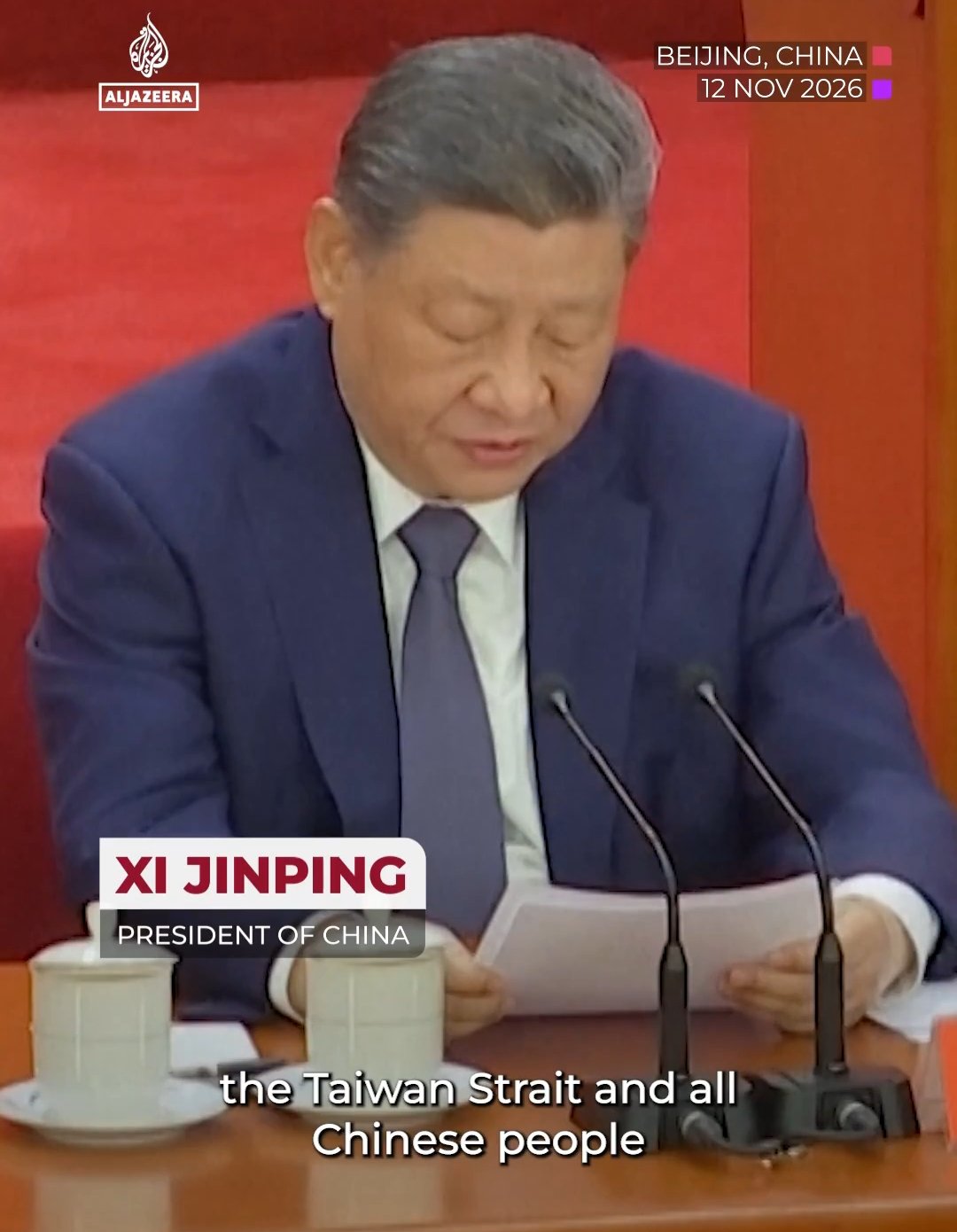
Chinese President Xi Jinping has renewed calls for Taiwan’s reunification with China, insisting that the goal will eventually be achieved while reaffirming Beijing’s commitment to a peaceful approach under its “one country, two systems” policy.
Xi made the remarks on Thursday, November 12, 2026, during a ceremony at the Great Hall of the People in Beijing to mark the 160th anniversary of the birth of Chinese revolutionary leader Sun Yat-sen.
The Chinese leader described reunification as an important historical mission of the Communist Party of China and said the movement towards achieving it could not be stopped.
According to reports, Xi urged people on both sides of the Taiwan Strait, as well as Chinese citizens at home and abroad, to oppose what Beijing describes as separatist activities and work towards peaceful cross-strait relations.
He maintained that China remained committed to peaceful reunification under the “one country, two systems” framework, which Beijing has proposed as a model for Taiwan’s future relationship with mainland China.
Xi also indicated that Beijing was willing to engage in dialogue with people in Taiwan on cross-strait relations and national reunification, provided discussions were based on the one-China principle and the 1992 Consensus.
However, his renewed position has met resistance from Taiwan, whose government has consistently rejected Beijing’s proposed political arrangement.
Taiwan’s Mainland Affairs Council said neither the island’s government nor its people would accept the “one country, two systems” framework, maintaining that Taiwan’s future should be determined by its people.
Taiwan operates its own democratically elected government, maintains its own military and functions separately from mainland China, despite Beijing’s longstanding claim over the island.
China has repeatedly maintained that Taiwan is part of its territory and has not ruled out the use of force to achieve reunification, although Xi’s latest remarks emphasised a peaceful approach.
The renewed declaration highlights the continuing political disagreement between Beijing and Taipei, with Taiwan insisting on preserving its democratic system and self-government while China maintains its objective of bringing the island under its control.
The issue remains one of the most sensitive geopolitical tensions in the Asia-Pacific region, with significant implications for regional security and relations between China and other global powers.
Source: Al Jazeera, with additional background from reports by the Associated Press and other international news outlets.