
By Gabriel Ameh
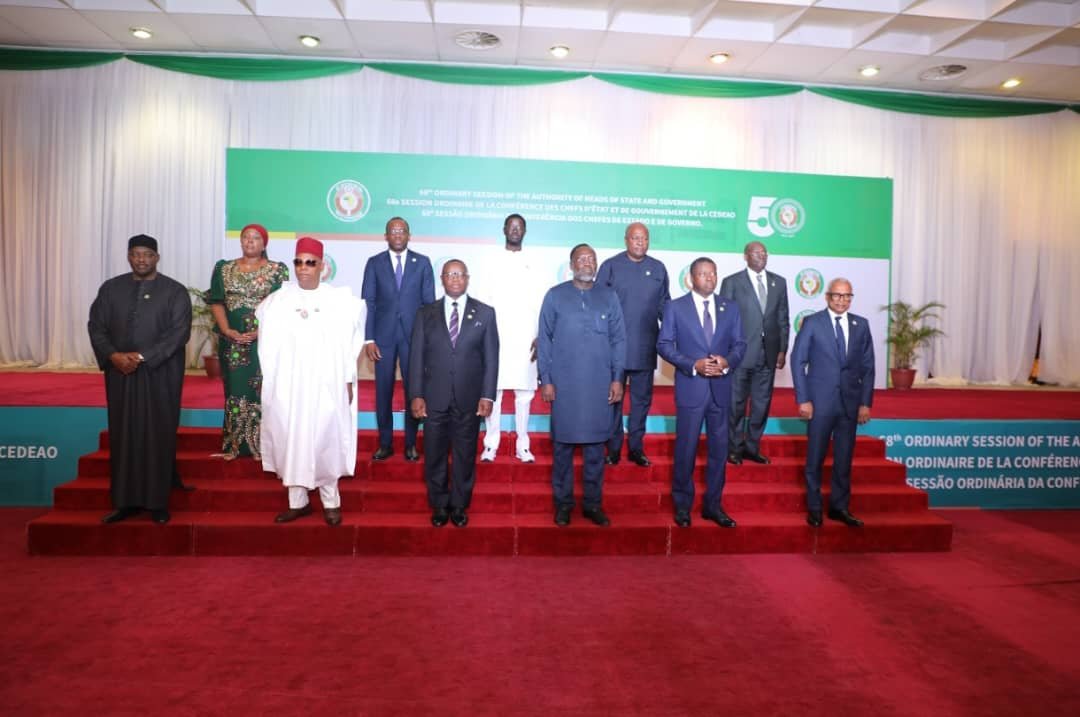
West African leaders on Sunday, 14 December 2025, gathered at the State House, Abuja, for the 68th Ordinary Session of the Authority of Heads of State and Government of the Economic Community of West African States (ECOWAS), a meeting widely regarded as a defining moment for the region’s future.
This was contained in a statement signed by
Kimiebi Imomotimi Ebienfa Spokesperson
Ministry of Foreign Affairs, Abuja on the
14th December 2025
Opening the summit, Nigeria, as host nation, reiterated its steadfast commitment to regional solidarity, collective security, and shared prosperity. Speaking on behalf of President Bola Ahmed Tinubu, Vice President Kashim Shettima described West Africa as a community bound not by accident but by history, culture, and a shared destiny. He noted that while disagreements among member states are inevitable, they must never erode fraternity or weaken the foundations of ECOWAS.
The high-level session brought together Heads of State and Government, Foreign Ministers, senior ECOWAS officials, representatives of the African Union (AU) and the United Nations (UN), international financial institutions, and members of the diplomatic corps.
Speakers across the session stressed that terrorism, violent extremism, unconstitutional changes of government, transnational organised crime, climate-related shocks, food insecurity, and irregular migration remain shared threats that no single country can effectively address alone.
Defence of democratic governance emerged as a central theme. Leaders strongly condemned recent unconstitutional developments in parts of the region, including the political crisis in Guinea-Bissau and the attempted disruption of constitutional order in the Republic of Benin. ECOWAS was commended for its swift, coordinated, and principled response through diplomatic engagement and the activation of regional security mechanisms, reinforcing the Community’s zero-tolerance stance on military takeovers and democratic backsliding.
In his address, the Chair of the ECOWAS Authority and President of the Republic of Sierra Leone, His Excellency Julius Maada Bio, described the 68th session as a historic milestone, coinciding with nearly five decades of ECOWAS’ existence. He urged leaders to renew the founding vision of the Community with unity and resolve, warning that instability in any one member state poses a threat to the entire region. President Bio pledged that under his leadership, ECOWAS would remain people-centred, security-driven, and firmly anchored on democracy and the rule of law.
Economic integration also featured prominently in the deliberations. Leaders reaffirmed their commitment to deepening regional trade, accelerating monetary convergence, and strengthening cross-border infrastructure in transport, energy, and digital connectivity. Particular emphasis was placed on the operationalisation of the ECOWAS Business Council, envisaged as a strategic platform to bridge governments and the private sector, mobilise regional capital, boost intra-regional investment, and enhance competitiveness across West Africa.
A landmark decision announced at the summit was the reduction of air travel costs within the region. Effective from 1 January 2026, ECOWAS member states will abolish selected air travel taxes and reduce passenger and security charges by 25 per cent. Leaders described the initiative as a tangible step toward bringing regional integration closer to citizens, facilitating mobility, promoting tourism, and strengthening social and economic ties.
Humanitarian and climate-related challenges also received significant attention. Leaders acknowledged the growing impact of climate change, flooding, displacement, and food insecurity, calling for stronger coordination with development partners, improved early warning systems, and increased investment in disaster risk management. Women and youth were identified as central to resilience, recovery, and sustainable development strategies.
In messages delivered on behalf of the United Nations and the African Union, both organisations commended ECOWAS for its firm stance on constitutional order and regional security, while reaffirming their commitment to deepen collaboration in counterterrorism efforts, democratic transitions, and addressing the root causes of conflict through inclusive governance and development.
As discussions moved into closed-door sessions, leaders expressed optimism that the 68th Ordinary Session would strengthen mutual trust and reposition ECOWAS as a more cohesive and effective regional bloc. The prevailing consensus was clear: unity is no longer optional but imperative for securing peace, stability, and prosperity for the region’s more than 400 million citizens.