
By Gabriel Ameh
Yiaga Africa has identified logistical delays, technical problems with the Bimodal Voter Accreditation System (BVAS), discrepancies in election data and alleged attempts at vote-buying during the Independent National Electoral Commission’s (INEC) nationwide mock accreditation and results upload exercise.
The election observation organisation said the challenges raised concerns about INEC’s operational preparedness ahead of the 2027 general elections, despite the BVAS performing satisfactorily in most polling units monitored.
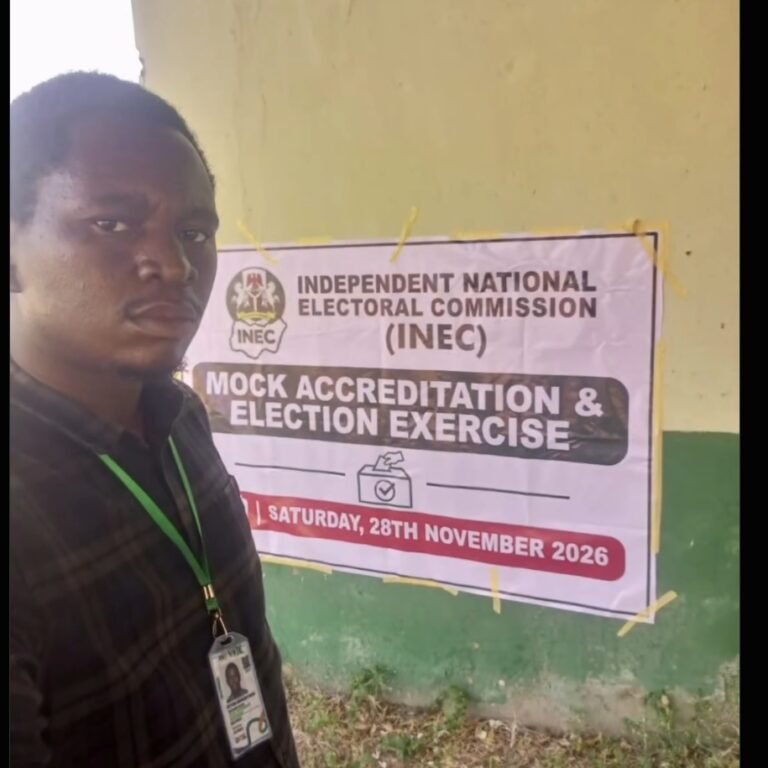
Yiaga Africa disclosed this in its preliminary statement on the mock exercise conducted by INEC on Saturday, November 28, 2026.
The organisation deployed its Process and Results Verification for Transparency (PRVT) methodology to observe the exercise in 300 sampled polling units nationwide. It also used its Election Results Analysis Dashboard (ERAD 2.0) to monitor and analyse the electronic transmission of polling-unit results.
Its assessment focused on the efficiency, functionality, integrity and accessibility of the electoral technologies and procedures.
According to Yiaga Africa, although BVAS worked effectively in most of the observed locations, the exercise exposed operational and technological weaknesses that require urgent attention before the 2027 elections.
Late Arrival of Officials, Election Materials
One of the major concerns identified was the late arrival of INEC officials and election materials at several polling units.
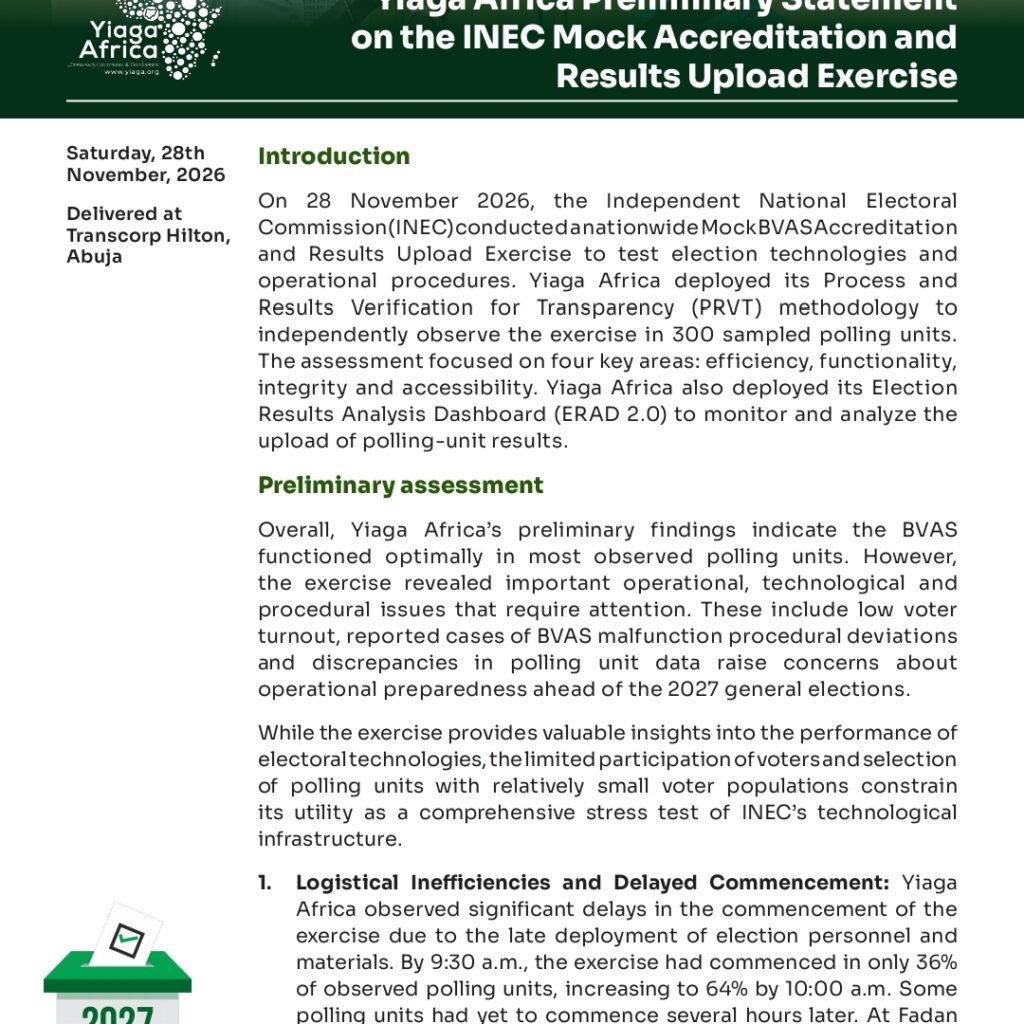
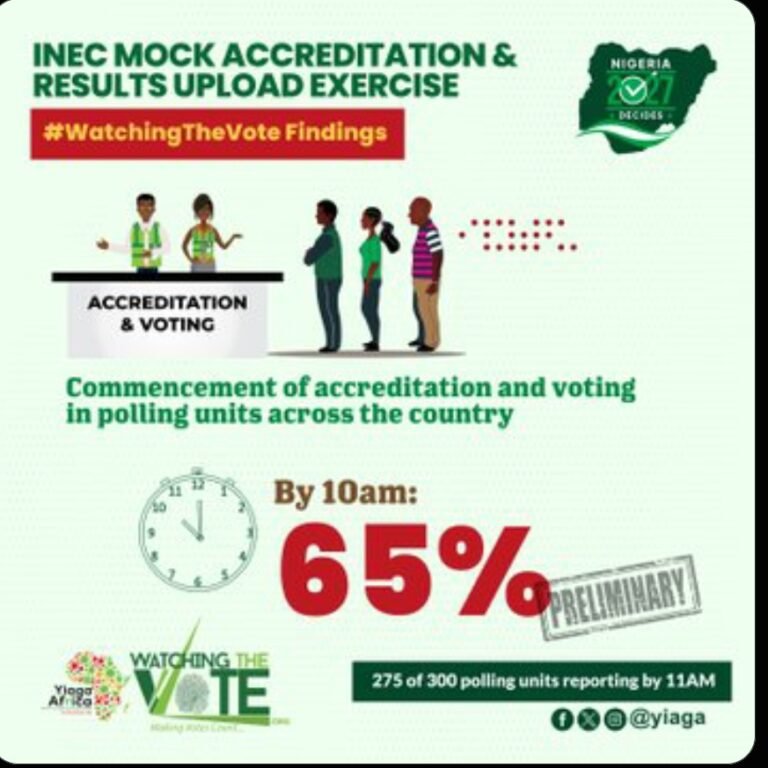
Yiaga Africa reported that only 36 per cent of the polling units observed had commenced the exercise by 9:30 a.m. The figure increased to 64 per cent by 10:00 a.m., while some locations were still waiting for officials several hours later.
At Fadan Karshil polling unit in Sanga Local Government Area of Kaduna State, INEC officials reportedly arrived at 1:40 p.m.
Similarly, officials had yet to arrive at Wanikde Playground polling unit in Yala LGA of Cross River State as of 1:30 p.m.
At Effraya International Market polling unit in Etung LGA, Cross River State, officials arrived without voting materials. Although accreditation commenced, voters were informed that ballot papers would arrive by 2:00 p.m.
The organisation said the incidents exposed weaknesses in logistics and the timely deployment of personnel and essential election materials.
Low Voter Turnout Raises Concerns
The group also expressed concern over the low participation of voters during the exercise, attributing it partly to inadequate public sensitisation and declining public trust in the electoral process.
Yiaga Africa recalled that it had urged INEC on November 19 to publish the operational framework and list of designated polling units early enough to encourage citizen participation.
Although the Commission published the list 48 hours after the organisation’s statement, Yiaga Africa said the limited mobilisation period may have affected public turnout and reduced the exercise’s ability to simulate actual election conditions.
BVAS Performs Well but Technical Problems Persist
On the performance of the BVAS, Yiaga Africa reported that the devices functioned satisfactorily in most polling units monitored.
Its findings showed that voters were processed within one to two minutes in 68 per cent of the observed polling units. Processing took between three and five minutes in 27 per cent, while four per cent recorded processing times of between six and 10 minutes.
However, some locations experienced technical difficulties.
At Oshin Ladega polling unit in Ikorodu LGA of Lagos State, INEC officials reportedly arrived with two BVAS devices instead of the three expected.
Some voters whose names appeared on the register also could not be authenticated using the devices.
At Gumbi/Wajake Yar Abba polling unit in Wamakko LGA of Sokoto State, a BVAS malfunction disrupted accreditation for about one hour. The problem was reportedly resolved after officials replaced the device’s MTN SIM card with an Airtel SIM card.
Another incident occurred at Maternity Ogunsola Filling Station polling unit in Ijero LGA of Ekiti State, where one of two BVAS devices malfunctioned.
The affected device had 512 registered voters assigned to it but could not be repaired locally because it was configured in Abuja.
Yiaga Africa called for stronger technical support, faster troubleshooting and effective contingency arrangements to prevent similar disruptions during the general elections.
INEC’s Polling Unit Figures, IReV Data Under Scrutiny

The organisation also identified discrepancies in INEC’s polling-unit figures and the configuration of its electronic results viewing portal.
According to the preliminary report, the IReV portal listed 176,846 polling units, while INEC’s recently released official figure stood at 177,299, leaving a difference of 453 polling units.
Yiaga Africa urged the Commission to clarify and reconcile the figures to strengthen transparency and public confidence.
It further identified a discrepancy in the number of Registration Areas (RAs) configured for the exercise.
Although the mock exercise was designed to cover 8,838 Registration Areas, the IReV backend was configured with only 8,791, leaving 47 areas unaccounted for.
These included 18 existing Registration Areas across 11 states and 29 additional areas in Delta State.
The organisation also identified inconsistencies in Local Government Area and Registration Area codes, including an interchange of Oju and Ohimini LGA codes in Benue State.
It warned that unresolved discrepancies could affect the receipt and publication of results from polling units in the affected areas.
Concerns Over Results Upload, Connectivity
Yiaga Africa also documented an alleged violation of results-upload procedures in Majema II polling unit, Tsanyawa LGA of Kano State.
According to the observers, the Presiding Officer reportedly declined to scan and upload the polling-unit result to IReV at the polling unit after the exercise.
Instead, observers were directed to the INEC office, where they were informed that the result would be uploaded.
The organisation said the development undermined transparency and independent verification of the results management process.
It also observed that some Presiding Officers relied on personal mobile phone hotspots to connect BVAS devices for accreditation data transmission and results uploads.
This, it said, raised concerns about the security of sensitive election information and the adequacy of INEC’s connectivity arrangements.
Yiaga Africa further noted that newly introduced safeguards designed to improve the integrity of scanned result sheets created difficulties in some locations.
In certain cases, BVAS devices reportedly rejected result sheets because of inconsistencies between the information on the sheets and the codes configured on the devices.
The organisation called on INEC to ensure that the safeguards are properly tested without preventing the timely upload of legitimate polling-unit results.
Vote-Buying Allegations, Disruption Reported
The preliminary findings also highlighted incidents that raised concerns about the integrity of the exercise.
In Ibeno Ward, Ibeno LGA of Akwa Ibom State, observers reported the distribution of ₦3,000 to voters and an alleged attempt to influence a Presiding Officer to inflate figures. The officer reportedly rejected the attempt.
At Akwanga Central School, observers also reported the distribution of ₦43,000 to individuals participating in the exercise.
In another incident at Market Square polling unit in Iwere-Ile Ward, Iwajowa LGA of Oyo State, an individual reportedly disrupted the exercise by tearing a ballot paper and was subsequently arrested by the police.
The absence of replacement ballot papers prevented affected voters from continuing with the voting process.
Yiaga Africa also reported the presence of party agents across the polling units observed, although representation varied among political parties.
Yiaga Africa Makes Recommendations to INEC
Following the findings, the organisation urged INEC to strengthen voter education and public mobilisation by releasing important election information sufficiently ahead of future exercises.
It also called for improved BVAS technical support, reliable connectivity and effective contingency arrangements to address device failures during elections.
The group asked INEC to review challenges associated with electronic results uploads and provide clear procedures for resolving technical errors without compromising the integrity of results.
It further recommended improved training and supervision of election officials to ensure compliance with established results-upload procedures.
On the IReV platform, Yiaga Africa called for system-level controls to prevent the upload of polling-unit results before the stipulated 2:30 p.m. threshold in the electoral guidelines.
The organisation said it would release a comprehensive report after the exercise.
It maintained that the lessons from the mock accreditation and results-upload exercise should be addressed urgently to strengthen electoral credibility, transparency and public confidence ahead of Nigeria’s 2027 general elections.