
By Media360Impact
The Independent National Electoral Commission (INEC) has challenged Nigerian political parties to take concrete steps to increase women’s participation in elective politics ahead of the 2027 General Elections.
The call came as fresh voter registration figures highlighted a widening gap between women’s strong participation as voters and their limited representation among political candidates and elected officials.
According to INEC, 2,037,589 women, representing 52.68 percent of the 3,867,997 Nigerians who completed registration in the third phase of the ongoing voter registration exercise as of July 26, 2026, were women.
Men accounted for 1,830,408 registrations.
The figures mean women made up more than half of all new registrants recorded during the phase.
However, their strong presence in the electorate has not translated into comparable representation in political office.
Women remain underrepresented in elective politics
INEC said women accounted for 44,414,846 of the 93,469,008 registered voters in the 2023 General Election, representing 47.52 percent of the electorate.
Yet only 1,556 of the 15,331 candidates who contested major elective positions in the 2023 elections were women, representing 10.15 percent.
The gap became even wider after the elections.
Only three women were elected to the Senate, representing 2.8 percent of the chamber, while 16 women won seats in the House of Representatives, representing 4.4 percent.

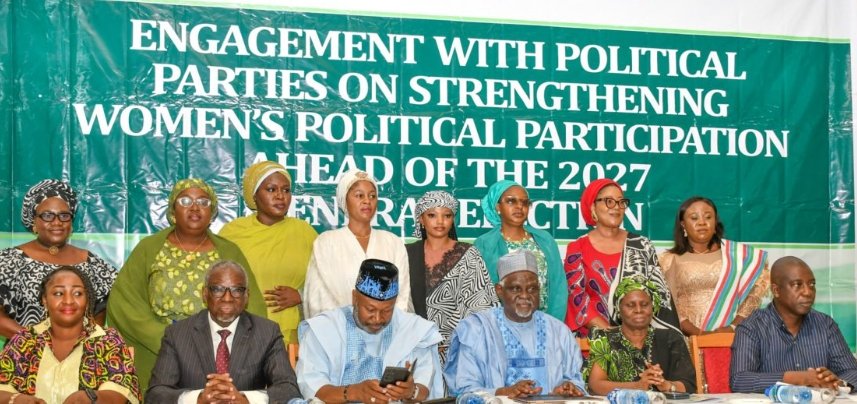
The figures formed the centre of INEC’s strategic engagement with political party leaders, female candidates, civil society organisations, development partners and the media in Abuja on September 9.
The commission used the engagement to demand measurable commitments from political parties ahead of the 2027 elections.
INEC: Political parties must move beyond promises
Delivering the opening remarks of INEC Chairman, Prof. Joash Amupitan, National Commissioner Prof. Rhoda Gumus said Nigeria’s democracy could not achieve full representation while women remained heavily involved at the voting level but largely absent from political leadership.
She described the issue as one that goes beyond a single election cycle, arguing that women’s political participation speaks to the inclusiveness and long-term sustainability of Nigeria’s democracy.
Gumus urged political parties to examine their internal structures and determine whether women have genuine opportunities to rise through party ranks and secure tickets to contest elective positions.
She identified party leadership and structures, campaign platforms, media visibility, fundraising, mentoring, political communication, logistics, security and grassroots mobilisation as areas where female candidates need practical support.
“The participation of women is not a favour to women. It is a democratic imperative,” she said, urging parties to move from “commitment to action, from aspiration to implementation.”
INEC presents seven-point agenda
The commission’s Gender and Inclusivity Department presented a seven-point agenda aimed at turning discussions on women’s participation into measurable commitments.
The agenda includes securing concrete commitments from political parties to support female candidates and ensuring equitable access to campaign resources and opportunities.
It also calls for greater visibility for women candidates, stronger protection against political violence, intimidation, harassment and discrimination, and a more supportive political environment.
INEC further wants political parties and stakeholders to sustain support for women beyond the 2027 elections while improving collaboration, monitoring and accountability.
Hembadoon Akaayar, Deputy Director, Gender Relations, said the commission expected political parties to leave the engagement with commitments that could be measured and followed up.
“Our expectation is that this engagement will produce practical and measurable commitments from participating political parties rather than general expressions of goodwill,” she said.
Why the numbers matter
The figures presented by INEC show that women are not a marginal part of Nigeria’s electorate.
They represented nearly half of registered voters in 2023 and accounted for more than half of new registrants in the third phase of the ongoing registration exercise.
Yet their presence among candidates and elected lawmakers remains significantly lower.
For INEC, the disparity shows that increasing the number of women who register and vote is only part of the challenge.
The bigger question is whether women can gain meaningful access to party structures, secure nominations, compete effectively and ultimately win elective positions.
Nigeria trails several African countries
The keynote speaker, Oluwole Osaze-Uzzi, Publicity, Gender and Civil Society Liaison and former Attorney General and Commissioner for Justice in Edo State, described Nigeria as a laggard in women’s political representation.
He noted that women constitute roughly half of Nigeria’s population and electorate but occupy only a small proportion of seats in the National Assembly.
He also pointed out that no woman has been elected president or governor since Nigeria returned to democratic rule in 1999.
However, Osaze-Uzzi noted a change at the presidential candidate level ahead of 2027, with three women among the 14 presidential candidates referenced at the engagement, compared with none in 1999.
He cited Rwanda, Senegal, Namibia, South Africa, Mozambique and Cape Verde as examples of African countries that have adopted different approaches to improving women’s political representation.
According to him, Rwanda increased female parliamentary representation dramatically after adopting stronger measures, while Senegal introduced a Parity Law in 2010.
He also cited voluntary party quota systems in some African countries and noted that many countries on the continent now operate some form of gender quota.
Financing, culture and insecurity remain barriers
Osaze-Uzzi identified inadequate financing, cultural barriers, insecurity, legal limitations and weak political will among the factors discouraging women from seeking elective office.
He called for stronger legal frameworks, enforceable mechanisms within political parties, dedicated campaign financing for women and structured mentorship programmes.
He also advocated zero tolerance for intimidation, threats and sexual harassment directed at female candidates.
2027 test for political parties
With political parties preparing for the 2027 electoral cycle, INEC’s intervention puts the spotlight on whether women’s numerical strength as voters can translate into greater political representation.
The commission is urging parties to provide women with greater access to leadership structures, campaign resources, media visibility, security and grassroots mobilisation.
The challenge is therefore no longer simply about encouraging women to vote.
It is about creating a political system in which the millions of Nigerian women who participate in elections can also have a realistic opportunity to contest, compete and lead.
As the 2027 elections approach, the question facing political parties is increasingly clear: will women remain a powerful voting bloc, or will they also become a stronger force in Nigeria’s elected leadership?