
By Gabriel Ameh
Abuja, Nigeria Tuesday, 2nd December 2025.
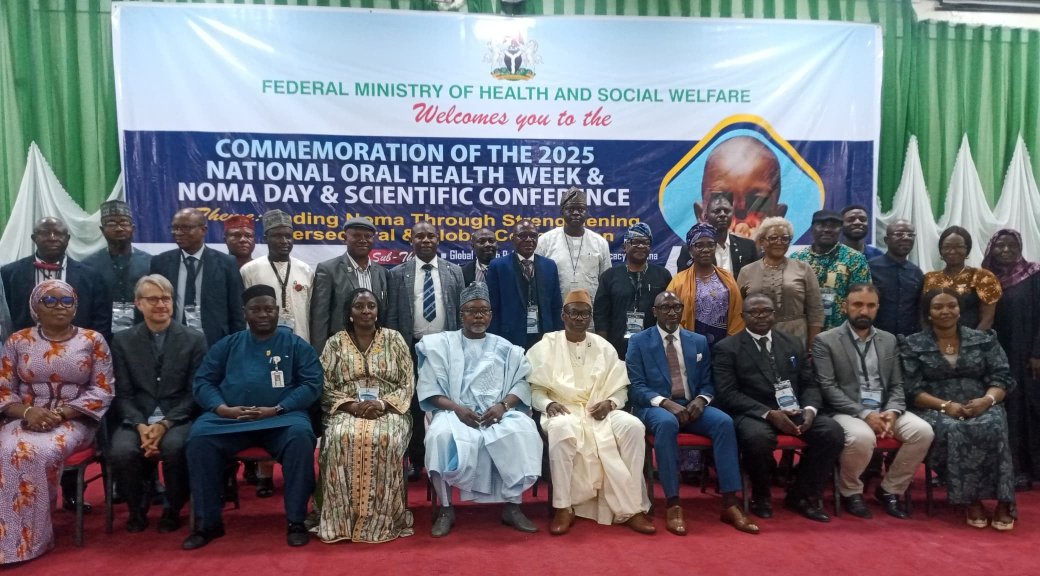
Nigeria has renewed its national and global commitment to eliminating Noma, a severe gangrenous disease affecting children in poor and underserved communities, as the Federal Ministry of Health and Social Welfare commemorated the 2025 National Oral Health Week and Noma Day Scientific Conference in Abuja.
The high-level gathering, themed:
“Ending Noma Through Strengthening Intersectoral and Global Cooperation,”brought together federal lawmakers, development partners, humanitarian organisations, researchers, medical experts and policymakers. Technical dialogues also explored the sub-themes:
– Global Health Policies, Research and Advocacy in Noma
– Advancing Surgical Care in Noma Disease
– Microbial Factors in Noma
Minister of State for Health: “Noma is Preventable and Nigeria Will End It.”
In his keynote address, the Honourable Minister of State for Health, Dr. Iziaq Adekunle Salako, described Noma as “a disease of poverty that we can and must defeat.”
He emphasised that Noma remains one of the most visible manifestations of extreme deprivation and weak access to early healthcare.
“No child should lose their face or their future to a disease that is entirely preventable. Nigeria is scaling up early detection, integrating Noma screening into routine immunisation visits, expanding community oral health programmes, and strengthening nutrition systems to protect our most vulnerable children.”
Dr. Salako announced ongoing reforms in:
– Community awareness and early case reporting
– Nutrition and hygiene interventions in rural areas
– Training frontline health workers in early diagnosis
– Strengthening surgical response for Noma survivors
– Collaboration with MSF, WHO, UNICEF and research institutions
He reaffirmed that Nigeria intends to lead Africa in eliminating Noma through stronger primary healthcare systems and sustained global cooperation.
Permanent Secretary Calls for Multi-Sectoral Action
The Permanent Secretary, Daju Kachollom S. mni, described Noma as “a disease that thrives where systems fail,” stressing the need for coordinated action across nutrition, water and sanitation, healthcare delivery, community education, and poverty alleviation.
She commended partners for their commitment and urged state governments, traditional institutions and community health workers to strengthen surveillance and public awareness.
MSF Country Director Delivers Powerful Humanitarian Perspective
One of the most compelling addresses came from the Médecins Sans Frontières (MSF) Country Director, Ahmed Aldikhari, who delivered an emotional and data-driven appeal for global action.
He noted that MSF has provided decades of medical, surgical and psychological support to Noma patients across West Africa, but warned that humanitarian efforts alone cannot eradicate the disease.
“Noma is not merely a medical condition it is the face of extreme deprivation. It is what happens when a child is denied nutrition, denied healthcare, and denied a chance to survive. When we treat a child with Noma, we are not just healing tissue; we are restoring identity, dignity and belonging.”
Aldikhari described the emotional toll faced by Noma survivors who struggle to speak, eat, smile or reintegrate socially due to profound facial disfigurement
He urged stronger global recognition of Noma as a Neglected Tropical Disease (NTD) and outlined five urgent priorities for eliminating Noma:
1. Formal global recognition and funding for Noma as an NTD
2. Expansion of reconstructive surgical capacity across Nigeria
3. Stronger early detection and community surveillance systems
4. More investment in research, especially microbial and environmental triggers
5. Comprehensive survivor rehabilitation, including psychosocial and speech therapy
He declared:
Nigeria has the leadership and capacity to change the future of Noma on this continent. Eliminating Noma requires government ownership, global solidarity, and a commitment to ensure that no child is ever again disfigured by preventable poverty.”
He ended by calling for a Global Compact on Noma Prevention and reaffirmed MSF’s commitment to deepen collaboration with the Federal Ministry of Health, teaching hospitals and civil society partners.
“Noma is a disease of poverty, but it should never be a disease of destiny. No Nigerian child should lose their face before they learn to smile.”
The hall erupted in applause.
Goodwill Messages from Key Partners
Goodwill remarks were delivered by:
– Noma Aid Nigeria Initiative (NANI)
– World Health Organization (WHO)
– UNICEF
All three organisations reaffirmed long-term support for Noma research, awareness, nutrition programmes and community-based prevention strategies.
Lawmakers and Key Government Officials Present
The event recorded the presence of high-level dignitaries including:
– Dr. Iziaq Adekunle Salako, Minister of State for Health
– Daju Kachollom S. mni, Permanent Secretary, FMOHSW
– Dist. Senator Ipalibo Gogo Banigo DSSRS, Chair, Senate Committee on Health
– Rt. Hon. Benjamin Kalu CFR, Deputy Speaker, House of Representatives
– Hon. Amos Gwamma Magaji, Member, National Assembly
– Hon. Dr. Yusufu Tanko Sununu, Minister of State, Humanitarian & Poverty Alleviation
– Permanent Secretaries from Agriculture, Women Affairs, and other sectors
– WHO and UNICEF Country Representatives
– Senior Special Assistant to the President on Humanitarian and Poverty Alleviation
Their participation underscored strong political will and inter-ministerial commitment to eradicating Noma in Nigeria.
Technical Sessions Highlight Research & Field Realities
Experts delivered presentations on:
– Global health policy and Noma advocacy
– Reconstructive and surgical approaches
– Microbial and environmental triggers of Noma
Community engagement and survivor support
These sessions provided a scientific roadmap for Nigeria’s Noma elimination strategy.
Nigeria Moves Toward a Future Without Noma
The 2025 National Oral Health Week and Noma Day Conference concluded with a renewed national pledge:
To end Noma through early detection, stronger primary healthcare systems, expanded surgical capacity, global funding partnerships and survivor-centred rehabilitation.
With stronger intersectoral collaboration and global solidarity, Nigeria is positioning itself to become a continental leader in the elimination of Noma ensuring that no child suffers or dies from this preventable disease.