
By Achile Month
Nigeria and the European Union have reiterated their commitment to strengthening a wide-ranging strategic partnership covering economic development, security cooperation, climate action and people-to-people engagement, as both sides push for more tangible outcomes in the coming years.
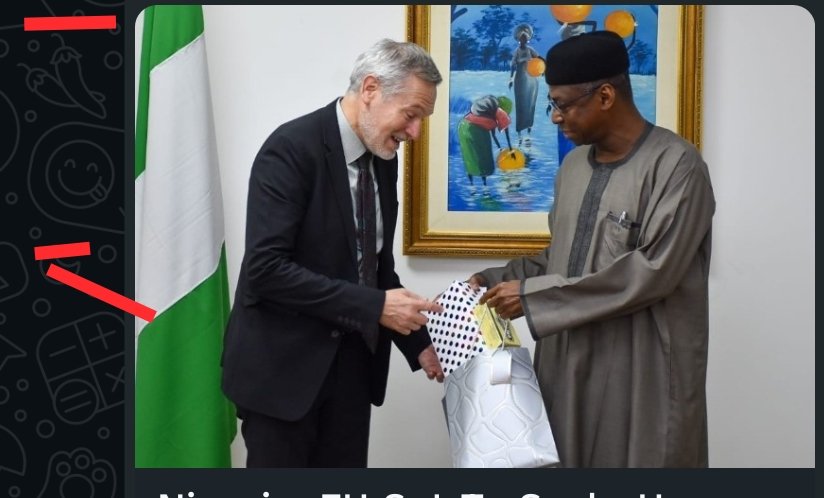
The commitment was reaffirmed in Abuja on Tuesday during a high-level meeting between the Permanent Secretary of the Ministry of Foreign Affairs, Ambassador Dunoma Umar Ahmed, and the European Union Ambassador to Nigeria and ECOWAS, Mr. Gautier Mignot.
Ambassador Ahmed described the EU as one of Nigeria’s most important development partners, noting that cooperation between both parties continues to expand across key sectors such as trade and investment, peace and security, governance, agriculture, health, education, the digital economy and humanitarian assistance.
He подчеркed that the administration of President Bola Ahmed Tinubu remains firmly focused on economic diversification, with priority areas including agriculture, innovation, climate-smart development and digital transformation.
Nigeria’s regional leadership role was also highlighted, with Ambassador Ahmed stressing the country’s commitment to promoting peace and stability in West Africa. He called for sustained EU collaboration in counter-terrorism, maritime security in the Gulf of Guinea and post-conflict recovery efforts across the region.
The Permanent Secretary further advocated increased support for climate adaptation, energy transition, green technology transfer and humane, cooperative migration frameworks that place youth empowerment at the centre.
In his response, EU Ambassador Gautier Mignot commended the strong alignment between Nigeria’s national development priorities and the EU’s strategic objectives, describing 2026 as a “pivotal year” for advancing the partnership.
He revealed that preparations are underway for a proposed Nigeria-EU Ministerial Meeting scheduled for March 2026 in Abuja, aimed at driving cooperation through structured dialogue and concrete commitments.
Ambassador Mignot also highlighted the EU’s Global Gateway Strategy, which is mobilising investments in infrastructure, digital connectivity, clean energy, agriculture and youth-focused programmes, while supporting Nigeria’s peace, security and regional stabilisation initiatives.
Both sides reaffirmed their shared commitment to multilateralism, the rule of law and the principles of the United Nations Charter, expressing confidence that Nigeria-EU relations will continue to deepen with measurable and lasting impact.