
By Gabriel Ameh
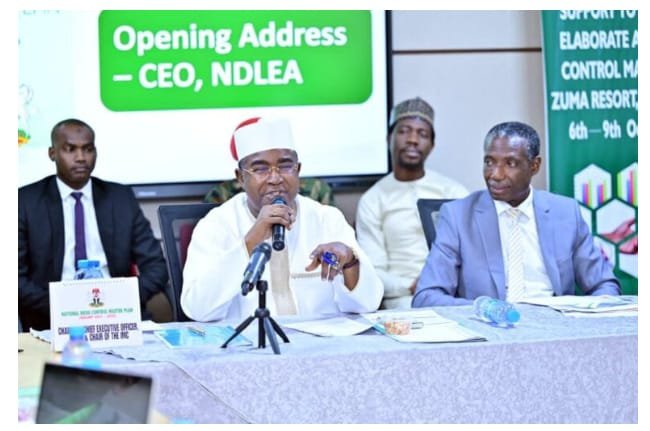
Niger State, October 6, 2025 Chairman and Chief Executive Officer of the National Drug Law Enforcement Agency (NDLEA), Brigadier General Mohamed Buba Marwa (Rtd), has charged stakeholders working on Nigeria’s next National Drug Control Master Plan (NDCMP 2026–2030) to ensure the new strategy tackles emerging and evolving threats in the country’s fight against illicit drugs.
This was contained in a statement signed by Femi Babafemi, Director, Media & Advocacy, NDLEA Headquarters, Abuja on Monday, 6th October 2025
According to the statement, Marwa gave the charge while declaring open a five-day residential workshop in Niger State on Monday, October 6, 2025. The workshop, organized with the support of the ECOWAS Commission and the United Nations Office on Drugs and Crime (UNODC), is aimed at developing Nigeria’s fifth National Drug Control Master Plan.
Marwa stated that, the 2026–2030 plan must be “visionary yet practical; comprehensive yet targeted; and nationally owned yet globally aligned.” He emphasized that the new strategy must not only consolidate past gains but also anticipate emerging challenges such as synthetic drugs, dark web trafficking, poly-substance abuse, and illicit financial flows sustaining the drug trade.
“The drug problem continues to evolve, and so must our response. The next Master Plan must build on past achievements while boldly addressing new and emerging threats,” Marwa said.
“This workshop is not just about producing another document it’s about charting a collective vision to safeguard the health, security, and wellbeing of Nigerians.”
The NDLEA boss reaffirmed the agency’s commitment to providing leadership, coordination, and technical support for the successful implementation of the plan. He also assured continued collaboration with ECOWAS and other international partners, stressing that drug challenges recognize no borders.
Marwa commended the ECOWAS Commission, European Union, UNODC, civil society organizations, and other partners for their continued support in strengthening Nigeria’s drug control framework.
Speaking on behalf of UNODC, Dr. Akanidomo Ibanga, representing Country Representative Cheikh Ousmane, lauded Nigeria’s commitment to drug control reforms, noting that the dynamic global drug situation requires adaptive, coordinated, and inclusive responses.
“This Master Plan offers a framework through which Nigeria can harmonize its response to align with international standards, including the three drug control conventions, the 2030 Sustainable Development Goals, and the African Union Plan of Action on Drug Control,” he stated.
Also addressing participants, Professor Fatou Sow Sarr, ECOWAS Commissioner for Human Development and Social Affairs, represented by Dr. Daniel Amankwaah, acknowledged Nigeria’s leadership role in regional drug policy development. She said ECOWAS’ financial and technical support reflects its commitment to helping member states design robust, evidence-based drug control strategies aligned with regional and international priorities.
“As Nigeria’s current National Drug Control Master Plan winds down, the new NDCMP must effectively respond to evolving trafficking patterns and the rising burden of substance use disorders,” she said.
The workshop brought together representatives from the Federal Ministries of Education, Health, Agriculture, Budget and Planning, as well as NACA, NAFDAC, EFCC, NFIU, and other key agencies and partners involved in the country’s drug control architecture.