
By Gabriel Ameh
The Zambian government has expressed keen interest in adopting and adapting Nigeria’s National Values Charter, a core component of the proposed Nigerian Identity Project recently approved by the Federal Executive Council (FEC).
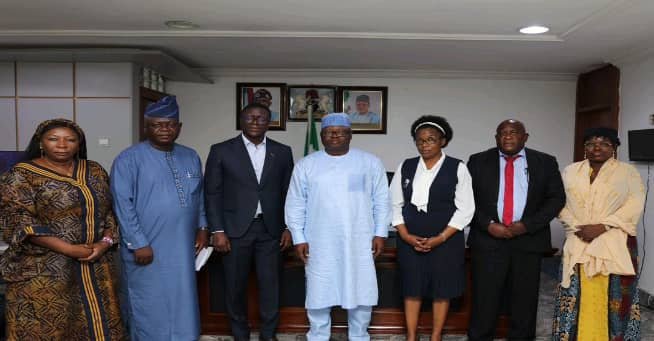
This development emerged during a courtesy visit by officials of the Zambian High Commission in Nigeria, led by the Deputy High Commissioner, Mrs. Jenipher Mutembo, to the headquarters of the National Orientation Agency (NOA) in Abuja. The Nigerian delegation was led by the Director General of the NOA, Mallam Lanre Issa-Onilu.
Welcoming the Zambian officials, Issa-Onilu provided an overview of the Agency’s nationwide operations and its pivotal role in bridging communication between the government and citizens.
“The National Orientation Agency is one of Nigeria’s largest public institutions, with 818 offices spread across the 774 local government areas, 36 states, and the Federal Capital Territory. We are firmly rooted at the grassroots and serve as a vital communication channel between the government and the people,” he stated.
The NOA boss explained that the Agency is responsible for communicating government policies, programmes, and projects to Nigerians while also collecting feedback from communities to inform decision-making. These reports, he noted, are regularly submitted to relevant ministries and the National Assembly.
Issa-Onilu further emphasized that the NOA promotes patriotism, civic responsibility, and national unity. He also recounted a similar engagement with the Gambian High Commissioner in London, underscoring the growing regional interest in Nigeria’s approach to civic education and national reorientation.
He observed that leadership in Africa is often narrowly perceived as political, urging a broader understanding that includes civil, traditional, and moral leaders as key influencers of national values.
In her remarks, the Zambian Deputy High Commissioner, Mrs. Mutembo, commended the NOA’s structure and reach, describing its grassroots presence as a model worth emulating.
“Your presence in every local government area is remarkable. This grassroots model is powerful and something Zambia, and indeed other African nations, can learn from,” she said.
She praised the Agency’s openness in allowing Zambia to observe and learn from its methodologies, noting the shared African values of unity, youth engagement, and cultural pride.
Mrs. Mutembo, however, expressed concern over the growing influence of Nigerian media content on African youth, especially the portrayal of occultism and superstitions in some Nollywood films.
“Nigeria is the cultural giant of Africa, and Nollywood is one of your strongest exports. But as a sister nation, we have growing concerns about the themes of rituals and superstition in some productions. Our young people learn from these stories, and what we portray has implications for African values and identity,” she cautioned.
She proposed stronger inter-agency cooperation between Zambia and Nigeria in areas such as civic education, grassroots mobilisation, cultural diplomacy, and media content exchange.
Reaffirming Zambia’s commitment to deepening bilateral relations, Mrs. Mutembo lauded NOA’s leadership and noted that Nigeria’s investment in national orientation could serve as a model for Zambia’s ongoing reforms in civic engagement and responsible citizenship.
Nigeria’s example demonstrates that structured national orientation can drive behavioral change, civic responsibility, and sustainable development. This is a path Zambia is eager to explore,” she concluded.
Paul Odenyi
Deputy Director (Press), National Orientation Agency