

By Gabriel Ameh
In a decisive move to consolidate President Bola Ahmed Tinubu’s digital transformation agenda, the Nigerian Communications Commission (NCC) has intensified efforts to safeguard telecom infrastructure, reduce Right of Way (RoW) costs, and attract major investments into Nigeria’s broadband ecosystem.
The Commission announced a raft of measures aimed at boosting broadband penetration, enhancing investor confidence, and securing digital infrastructure nationwide vital steps in advancing the administration’s Renewed Hope Digital Economy Vision.
Joint Action on Infrastructure Security
To tackle persistent vandalism and infrastructure sabotage, the NCC, in partnership with the Office of the National Security Adviser (ONSA), has established a Telecommunications Industry Working Group. The initiative will enforce site security standards and launch a national awareness campaign to sensitize communities on the importance of protecting telecom assets.
According to the NCC, the collaboration has already yielded results, with ONSA dismantling key criminal cartels involved in telecom equipment theft. The Commission is also working closely with state governments and the judiciary to ensure deterrence through effective prosecution of offenders.
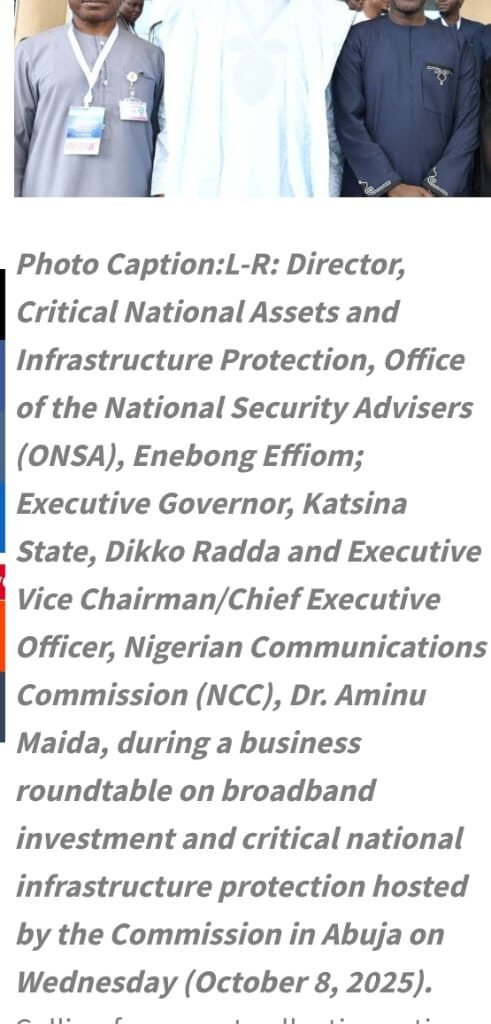
Cutting Right of Way Costs to Expand Access
Highlighting one of the industry’s longstanding barriers, the Executive Vice Chairman (EVC) of the NCC lamented the continued high cost of Right of Way (RoW) fees across some states, despite a Nigerian Governors Forum (NGF) resolution pegging the rate at ₦145 per linear metre.
Through sustained advocacy, five additional states Adamawa, Bauchi, Enugu, Benue, and Zamfara — have now completely waived RoW fees, bringing the total number of compliant states to eleven, while seventeen others have implemented the ₦145 cap.
The EVC affirmed the Commission’s commitment to achieving a uniform national RoW policy and promoting a “dig-once” infrastructure policy to prevent fibre damage, reduce deployment costs, and encourage shared infrastructure use among operators.
New Investments, Tariff Reforms, and Open Access Initiatives
To boost investor confidence, the NCC in 2025 approved cost-reflective and competitive tariff frameworks, paving the way for operators to commit over $1 billion in new broadband expansion projects.
Additionally, the Commission commissioned a wholesale fibre study to support open-access models, enhance last-mile connectivity, and deepen broadband reach in underserved areas.
Rising Threats: Vandalism and Fibre Cuts
Despite these gains, challenges persist. Between January and August 2025, Nigeria recorded 19,384 fibre cuts, 3,241 equipment theft cases, and over 19,000 incidents of site access denial disruptions that caused prolonged service outages, revenue losses, and mounting security costs for telecom operators.
Other obstacles include fragmented RoW regimes, weak coordination with road authorities, energy instability, multiple taxation, and bureaucratic bottlenecks in obtaining construction permits.
Broadband as a Lifeline for Development
The EVC stressed the urgent need for collective action to secure Nigeria’s digital infrastructure, warning that the global digital race is accelerating amid advances in artificial intelligence (AI), automation, and outsourcing.
“If our broadband backbone is weak, our youth will be marginalized, and our economy will not reach its full potential,” he cautioned.
“In earlier eras, a community without a railway or electricity could still subsist. But today, a community without digital connectivity is invisible, cut off from education, markets, healthcare, and opportunities.”
National Unity for a Secure Digital Future
The broadband protection roundtable convened governors, ministers, and private-sector stakeholders, reaffirming Nigeria’s shared resolve to secure its digital infrastructure and sustain the broadband growth essential for national development and security.
With the NCC’s renewed drive, the Commission aims to ensure that every Nigerian community remains connected, competitive, and secure in the digital age.