
By Gabriel Ameh Media360impact Editorial Room [Publication] | January 2026
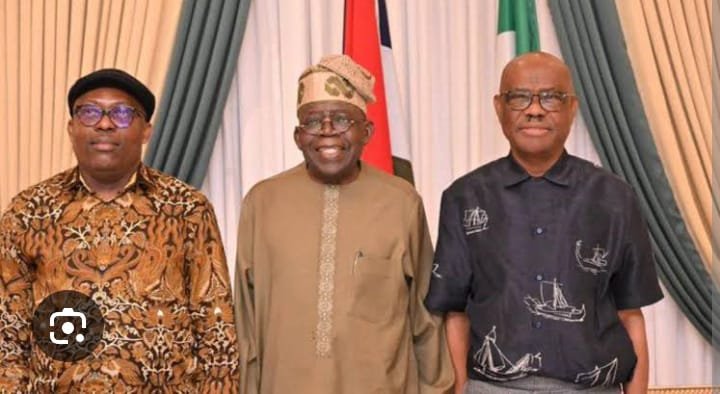
Port Harcourt & Abuja The political landscape in Nigeria’s oil-rich Rivers State has become a microcosm of national power struggles spotlighting intense rivalry, federal intervention, party defections, and the looming 2027 presidential contest. At the centre of this storm are two political heavyweights: Nyesom Wike, the Federal Capital Territory (FCT) Minister and former governor of Rivers State, and Siminalayi Fubara, his successor as governor. Their conflict has not only shaken the foundations of Rivers politics but has also posed difficult questions for President Bola Tinubu, whose support both men now court ahead of the next general election.
From Godfather to Adversary: The Wike Fubara Rift
When Siminalayi Fubara emerged as Rivers State governor in May 2023, it was widely viewed as a continuation of Nyesom Wike’s political influence in the state. Wike a former governor (2015–2023) with a strong grassroots political machine had helped install Fubara, but the alliance soon soured.
Disagreements between the two men escalated rapidly, marked by accusations of misgovernance, control of state resources, and political sabotage. The discord reached a boiling point in early 2025 when Rivers State’s House of Assembly, divided along pro-Wike and pro-Fubara lines, threatened impeachment proceedings against the governor a dramatic escalation in the political conflict.
The Emergency Rule: Tinubu’s Intervention
On March 18, 2025, President Bola Tinubu invoked Section 305 of the Constitution to declare a state of emergency in Rivers State, citing the escalation of violence, breakdown of governance, and political instability. Under this decree, Governor Fubara, his deputy, and most members of the House of Assembly were suspended, and retired Vice Admiral Ibok-Ete Ibas was installed as sole administrator.
The move was controversial. Critics argued it was an overreach of federal power and a political manoeuvre that favoured Wike the de facto architect of the political crisis. Others defended the intervention as necessary to prevent violent conflict and restore stability.
During this six-month emergency rule, Wike’s allies consolidated influence, reshaped political structures, and conducted local government elections that further weakened pro-Fubara forces. Reports indicate that the emergency rule, ironically, revived Fubara’s political prospects by halting impeachment and laying the groundwork for his return.
When the six-month military-style governance ended in September 2025, Fubara was reinstated as governor. True to political realism, he pledged loyalty to both President Tinubu and Wike, signalling a tactical peace rather than full political reconciliation.
Defection to APC and Political Realignment
In a dramatic twist in December 2025, Governor Fubara defected from the Peoples Democratic Party (PDP) to the All Progressives Congress (APC) Nigeria’s ruling party. His defection was not just symbolic; it signalled a pivot to secure political survival and relevance amid changing power dynamics.
However, the Rivers PDP reacted with anger and accusations of betrayal, claiming Fubara misled them and took their “mandate” to the APC for political expediency.
Wike, meanwhile, has downplayed Fubara’s perceived stature within the APC. He insists that defection alone does not make Fubara the party’s leader in Rivers arguing that party influence is rooted in grassroots control rather than title or timing of registration.
Who Does Tinubu Need Most for 2027?
With the 2027 general election approaching, President Bola Tinubu faces complex calculations in choosing allies who can deliver votes, stabilise volatile regions, and strengthen APC’s foothold across Nigeria.
Here’s how both figures stack up:
📌 Nyesom Wike The Power Broker
✔ Grassroots Infrastructure: Wike maintains strong networks at the ward and local government levels the fundamental structures for political mobilisation.
✔ Influence in Rivers and South-South Politics: His role as FCT Minister gives Tinubu a key ally in the strategic South-South region crucial for balancing APC’s support base beyond its Northern strongholds.
✔ Mediator Role: Wike has shown political resilience by managing rival factions, negotiating truces, and brokering peace critical attributes for a ruling party aiming for national cohesion.
📌 Challenges: Wike’s political style is polarising; critics argue his methods contribute to internal party fractures and may alienate independent voters.
📌 Siminalayi Fubara — The Pragmatic Governor
✔ Incumbency Advantage: As sitting governor of Rivers State, Fubara has executive leverage, visibility, and access to state resources significant for campaign mobilisation.
✔ APC Loyalty: His defection strengthens APC’s presence in Rivers, and a bloc of lawmakers followed him into the ruling party boosting APC’s local appeal.
✔ Tinubu Backing: The federal government’s intervention in 2025 arguably safeguarded his political career making Fubara more loyal to Tinubu’s national project.
📌 Challenges: Wike’s dismissal of his leadership credentials within APC highlights internal fractures. Fubara must still consolidate grassroots support to be effective in 2027.
Final Assessment: Balancing Power and Electability
President Tinubu’s best strategy lies in balancing both men’s strengths rather than choosing one unequivocally:
Wike offers deep grassroots networks and influence that can drive voter turnout and party loyalty in the South-South a critical region for APC’s expansion.
Fubara, as governor and APC member, provides institutional leverage and continuity, key for securing Rivers State’s electoral votes in 2027.
Ultimately, Tinubu may need Wike’s organisational muscle and Fubara’s executive platform to construct a winning coalition a fusion that turns rivalry into strategic partnership.
Media360Impact Editorial Opinion
The political saga of Rivers State underscores a larger truth in Nigerian politics: power is fluid, alliances are transactional, and political survival often requires adaptation. Wike’s influence remains potent, but Fubara’s resurgence within the APC demonstrates that political fortunes can change quickly especially when federal power intervenes.
For President Tinubu, harnessing the strengths of both leaders without alienating either will be a central challenge heading into 2027 one that could define the future of Nigerian political alignments.