By Gabriel Ameh
Abuja, November 3, 2025 The Director General of the National Orientation Agency (NOA), Mallam Lanre Issa-Onilu, has announced that Nigeria’s ongoing battle against insecurity and corruption is producing concrete, data-backed results across multiple sectors.
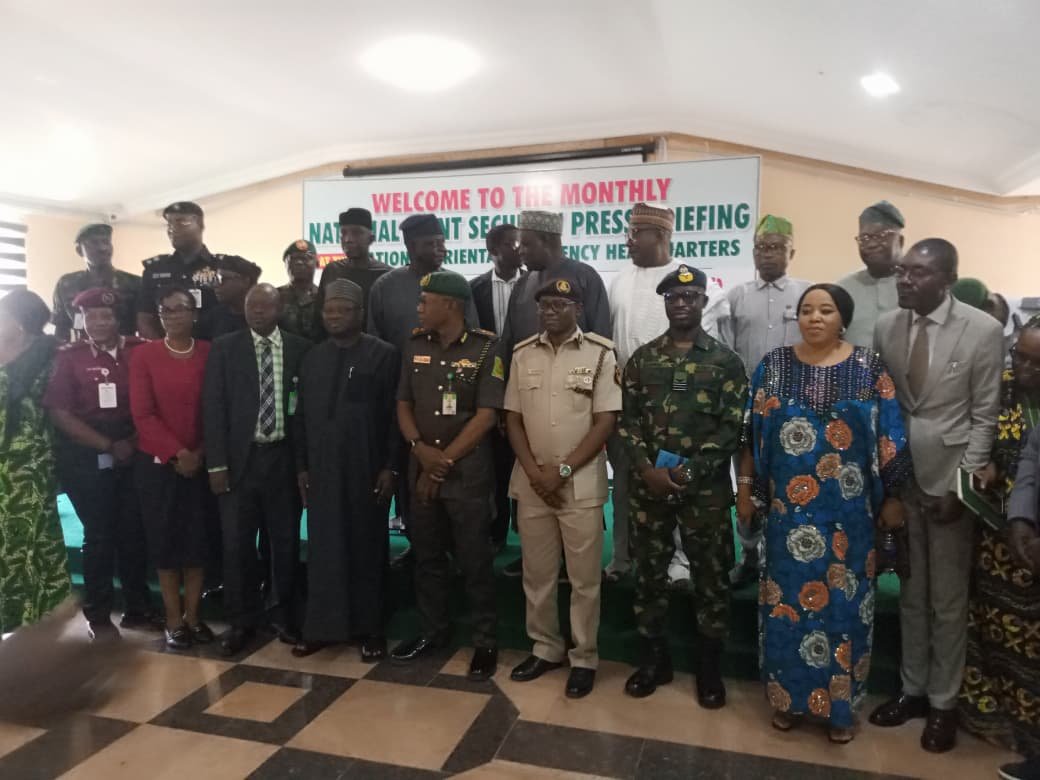
Speaking during the October 2025 Joint Security Press Briefing (JSPB) at the NOA headquarters in Abuja, Issa-Onilu said recent statistics demonstrate a “clear and measurable improvement” in both security outcomes and anti-corruption enforcement.
“What we have today is not rhetoric it is measurable progress,” he declared. “For the first time in years, our security and anti-corruption agencies are working within a single intelligence and communication ecosystem. This is the Renewed Hope Agenda in action.”
According to fresh national data presented by the NOA DG, fatalities from violent crimes fell by 12% between September and October 2025 from 210 to 185 deaths, while arrests of major suspects rose by 33%, credited to stronger intelligence coordination among the military, police, and intelligence agencies.
He added that rescues of abducted victims increased by 40% in states such as Kogi, Zamfara, and Kaduna, while cross-border security operations grew from four to seven cases due to improved collaboration between the Nigeria Immigration Service (NIS), Defence Intelligence Agency (DIA), and Department of State Services (DSS).
“Security is no longer reactive it’s preventive,” Issa-Onilu emphasized. “Lives are being saved before threats escalate.”
Anti-Corruption Drive Gains Momentum
The NOA DG highlighted major progress in anti-corruption enforcement, noting that the ICPC received 44 petitions, concluded 15 investigations, filed 5 new cases, and recovered ₦840 million and $919,000 in October alone.
He also cited achievements of the EFCC under Chairman Ola Olukoyede, revealing cumulative recoveries of ₦566.3 billion and $411.6 million between 2023 and 2025, with over 1,500 properties forfeited. Some of the recovered funds, he said, have been reinvested into student loan and consumer credit schemes.
“This is Renewed Hope Accountability in practice,” Issa-Onilu said. “For the first time, recovered loots are being recycled into the economy funding education, credit, and healthcare.”
Agency Coordination and National Impact
The NOA DG further commended the achievements of several key agencies:
NAFDAC intercepted 70 containers of counterfeit or substandard goods in Lagos and Onitsha.
NDLEA dismantled 14 major drug cartels, arrested 1,378 suspects, and secured 251 convictions in October.
NIS rescued 76 victims of human trafficking and processed 15,000 digital visas under its new migration system.
FRSC recorded a 12% reduction in fatal road crashes during its Ember Months campaign.
NCoS expanded mental health and rehabilitation programs across correctional facilities.
“The numbers tell a clear story,” Issa-Onilu noted. “Every enforcement action, prosecution, and recovery is now tracked, verified, and publicly reported. Government agencies are operating with efficiency through accountability.”
Building Trust Through Communication
Highlighting the role of public communication in national security, Issa-Onilu said the NOA reached over 32 million Nigerians between August and October 2025 through civic education and digital campaigns promoting unity, vigilance, and fact-checking.
The Agency also recorded a 28% increase in public outreach, 40% rise in fact-checking interventions, and 39% growth in community partnerships.
“Trust is Nigeria’s strongest security asset,” Issa-Onilu said. “Accurate information saves lives. In this digital era, communication itself is a weapon for peace.”
He described the inter-agency collaboration model as a “whole-of-government approach,” which he said has become an emerging global model for synchronizing security, governance, and communication.
“Under President Bola Ahmed Tinubu’s Renewed Hope Agenda, the system now works as one no more silos, no more secrecy.”
Citizens as Partners in Security
Issa-Onilu urged Nigerians to complement government efforts by staying vigilant and reporting suspicious activities, emphasizing that security begins at the community level.
“Every citizen is part of Nigeria’s security architecture,” he declared. “Security does not start from Abuja it starts from our streets, markets, schools, and neighborhoods.”
Concluding, Issa-Onilu said October’s progress report marks “a turning point from distrust to shared confidence between citizens and institutions.”
“Together, through courage, collaboration, and communication, we are rebuilding the moral foundation of our democracy. Together we build trust. Together we build peace. Together we build Nigeria.”